
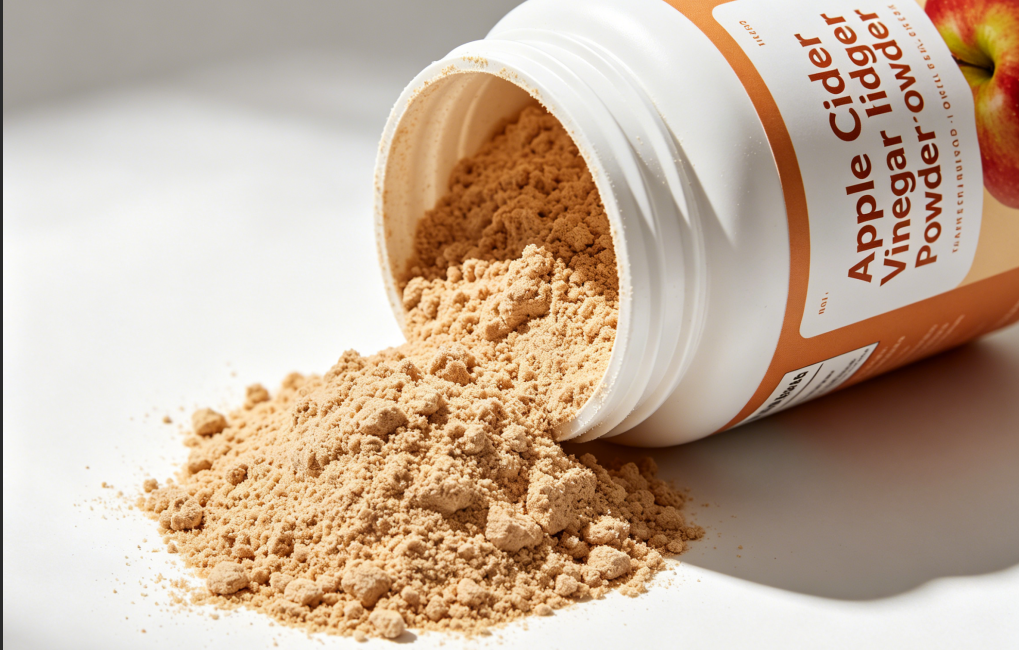
What Is Apple Cider Vinegar Powder?
Derived from fresh Malus domestica apples, this powdered form retains the core active compounds of liquid apple cider vinegar, including acetic acid, pectin, and natural organic acids. Compared with traditional liquid vinegar, ACV powder eliminates strong sour odors, avoids enamel erosion, and features easier storage, transportation, and formulation compatibility. It has become a popular raw material for functional foods, dietary supplements, and beauty personal care products worldwide. Manufacturers distinguish organic-grade and food-grade specifications to meet diverse market certification demands.
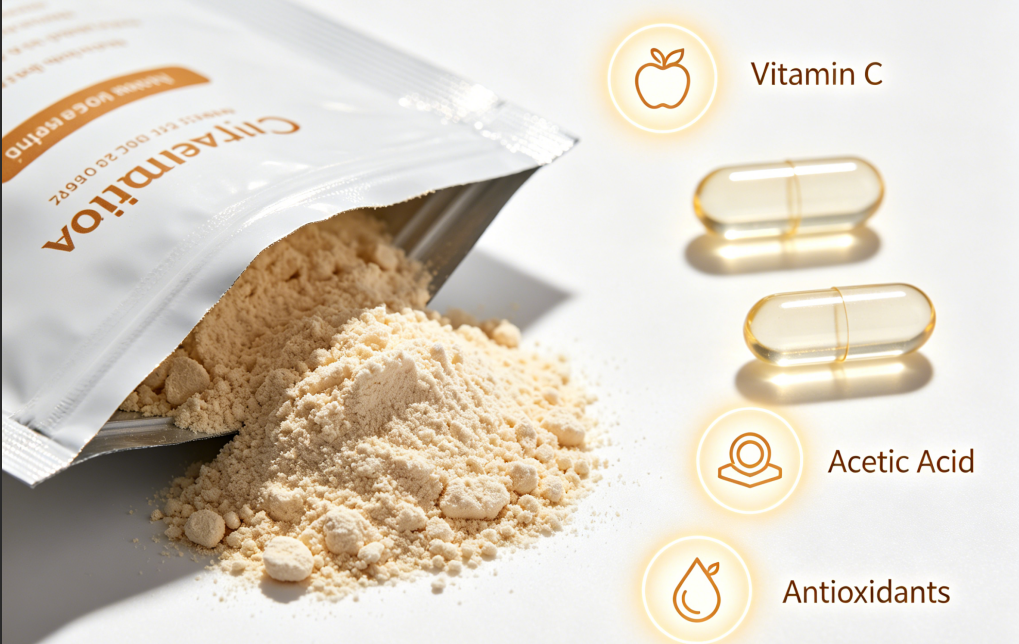
Apple Cider Vinegar Powder Benefits for Human Health & Beauty
As a versatile natural ingredient, apple cider vinegar powder delivers multiple benefits covering physical conditioning and daily skincare. Among consumer demands, apple cider vinegar powder benefits for weight management remain the most searched advantage. Rich in pectin and organic acids, it helps suppress appetite, enhance satiety, and boost metabolic efficiency. Moderate supplementation assists the body in fat decomposition and calorie consumption, making it a mainstream ingredient in weight-management supplements.
Beyond weight regulation, it supports stable blood sugar levels by reducing fasting blood glucose and optimizing insulin sensitivity. For digestive health, natural acetic acid balances gastrointestinal flora and relieves bloating and indigestion. In beauty applications, its mild acidic properties balance skin pH, remove dead skin cells, and reduce acne and blemishes. It also serves as a scalp conditioner to eliminate oil buildup, relieve dandruff, and maintain healthy hair follicles. Such multi-scenario benefits make it highly attractive for B2B buyers in health and beauty industries.
Apple Cider Vinegar Powder – Specification Overview
Active Ingredients & Acidity Indicators
The core functionality of this product is derived from its organic acid content. A key indicator is its total acidity (expressed as acetic acid), for which a typical industry value is set at not less than 25%. Beyond acetic acid, the product also contains other naturally occurring organic acids such as malic acid, which together contribute to its characteristic sour taste and functional properties. The specific values for total acidity and malic acid content should be verified against the Certificate of Analysis (COA) provided for each batch.
Physical Properties
In terms of physical form, Apple Cider Vinegar Powder is a fine powder, typically off-white to light yellow in color. It exhibits good water solubility, making it suitable for use in beverages and instant drink mixes. The particle size is generally fine (e.g., able to pass through an 80-100 mesh sieve) to ensure good dissolution and blending uniformity, though specific particle size requirements can often be customized according to client needs.
Physicochemical Indicators
To ensure product stability and purity, key physicochemical parameters include moisture, ash, and pH. Moisture content is typically controlled at a low level (e.g., not exceeding 5.0% ) to prevent caking and degradation. Ash content (e.g., not exceeding 2.0% ) reflects the total inorganic matter. When the product is dissolved in water (e.g., as a 1% solution), the pH is acidic, generally falling within the range of 3.0 to 4.0. These values represent industry typicals; the specific standards are subject to the product’s COA.
Safety Indicators
Regarding safety, the product must strictly control heavy metal content, with specific limits for elements like lead (Pb) and arsenic (As), typically below 1.0 mg/kg. Furthermore, the product must comply with microbiological limits, including standards for total plate count, yeast and mold, and must test negative for pathogens such as E. coli and Salmonella to ensure its safety as a food or dietary supplement ingredient.
Recommended Dosage & How to Use Apple Cider Vinegar Powder
Many new users and brand merchants inquire abouthow to use apple cider vinegar powder correctly for better absorption and safety. For daily oral supplementation, the standard dosage is 1 to 3 grams per day. It is strongly recommended to mix the powder with warm water instead of taking it directly, effectively lowering acetic acid irritation to the gastric mucosa and tooth enamel.
The best intake time is 30 minutes before meals to aid digestion and control appetite. For beauty DIY usage, users can blend the powder with clay or honey to make exfoliating face masks, leaving the mixture on the skin for 20 minutes before rinsing. In industrial production, the powder can be added to solid beverages, capsules, and skincare toners. It is forbidden to take high doses on an empty stomach; people with sensitive stomachs should reduce daily intake to avoid physical discomfort.
Apple Cider Vinegar Powder Side Effects & Safety Warnings
Although classified as a safe natural food ingredient, improper intake of apple cider vinegar powder may cause mild side effects. Excessive consumption may lead to gastric acid reflux, stomach burning, and tooth enamel corrosion due to acetic acid. Long-term high-dose intake may also affect potassium balance in the human body.
Specific crowd restrictions need clear attention: people with gastric ulcers, severe acid reflux, hypoglycemia patients, pregnant and breastfeeding women should avoid continuous supplementation. For storage, keep the powder sealed in a cool and dry environment to prevent moisture agglomeration. All products comply with international food-grade standards without harmful additives, helping B2B merchants reduce market compliance risks and improve product safety credibility.
Apple Cider Vinegar Powder Wholesale & Bulk Purchase Guide
With the booming global demand for natural functional ingredients, bulk procurement has become the primary choice for distributors and processing factories. A reliable apple cider vinegar powder bulk supplier can provide stable supply, transparent testing reports, and competitive wholesale prices. Our factory provides food-grade and organic-grade ACV powder with flexible MOQ to satisfy small-batch trial orders and large-scale bulk procurement.
We support diversified packaging solutions, including bulk kraft paper bags for raw material processing and customized small sachets for finished products. Every batch is third-party tested for purity, heavy metals, and microbial indicators, with complete COA certificates for customs clearance and shelf sales. Compared with spot traders, direct factory procurement cuts intermediate costs and ensures stable raw material quality, which is suitable for long-term cooperative brands.
Summary of Core Apple Cider Vinegar Powder Specifications
For B2B buyers, the quality of apple cider vinegar powder is defined by a set of key parameters that ensure product performance, safety, and compliance. These specifications should be verified against the supplier’s Certificate of Analysis (COA) for each batch.
Physical and Chemical Properties
The product is typically a fine, free-flowing powder, appearing off-white to light yellow in color . It has a characteristic vinegar odor and taste. Its solubility in water makes it suitable for beverages, dry mixes, and other formulations .
The total acidity, expressed as acetic acid, is the most critical quality indicator. Commercial grades are typically standardized to 5% to 10% acetic acid on a dry basis . For products where a higher concentration is needed, specifications up to 10% are common, and we recommend confirming the exact percentage with the supplier for your application.
For moisture control, the loss on drying is typically limited to a maximum of 5% to 7% . The pH of a 1% or 10% solution generally falls within the acidic range of 2.7 to 4.0 . Particle size is often specified as 100% passing through an 80-mesh screen to ensure good dissolution and blending properties .
Purity and Safety Indicators
Heavy metal content is strictly controlled. Typical limits include lead at ≤ 2.0 mg/kg, arsenic at ≤ 1.0 mg/kg, and mercury at ≤ 0.1 mg/kg . Total heavy metals, as lead, are generally limited to ≤ 10 mg/kg .
Microbiological limits for food and supplement use are critical. Total plate count is generally ≤ 1,000 CFU/g, with yeast and mold at ≤ 100 CFU/g . Pathogens such as E. coli and Salmonella must be absent (negative) in the sample .
Quality Control and Authentication
A key point for buyers is to ensure the authenticity of the product. Some suppliers may fortify apple cider vinegar powder with non-naturally occurring acids, which common titration methods may not detect . As a standard of quality, we recommend requesting a COA that uses HPLC (High-Performance Liquid Chromatography) to confirm the identity and natural composition of the acids, ensuring the product’s integrity .
How to Choose a Trusted Apple Cider Vinegar Powder Supplier
Supplier qualification directly determines product quality and market competitiveness. When selecting cooperative manufacturers, buyers should prioritize suppliers with standardized fermentation workshops and spray-drying production lines. Formal suppliers must provide raw material traceability records, organic certifications, and food safety qualification documents. Avoid unprocessed crude powder with excessive impurities and unstable acidity.
As a professional natural ingredient manufacturer, we own independent production bases and complete quality control systems. We support private label customization, formula debugging, and personalized packaging design. Whether you need raw material bulk supply or finished product OEM services, we can provide one-stop solutions. We offer free sample testing to help buyers verify product quality before large-scale cooperation.
Ready to try Apple Cider Vinegar Powder for your business? Contact us at for a free sample or wholesale price list.
Leave A Comment