
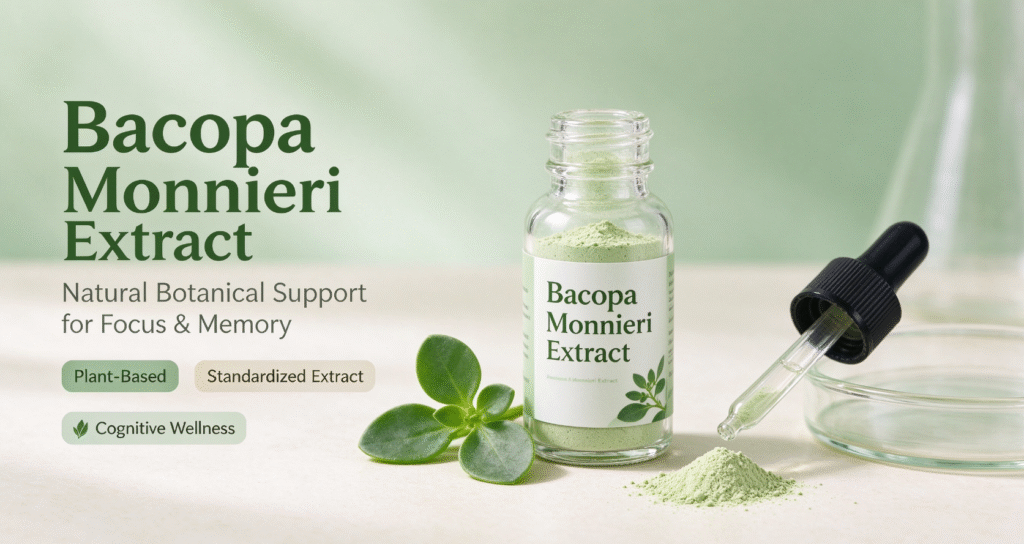
In the rapidly evolving landscape of nootropic and brain-health ingredients, few botanicals bridge traditional wisdom and modern science as seamlessly as Bacopa monnieri. Known in Ayurvedic medicine as “Brahmi”—a name derived from “Brahma,” the Hindu god of creation—this humble wetland herb has been used for centuries to enhance memory, sharpen intellect, and promote longevity . Today, Bacopa monnieri extract has transcended its traditional roots to become a cornerstone ingredient in the global cognitive health market, commanding serious attention from formulators, supplement brands, and B2B buyers seeking evidence-backed natural solutions for brain performance and neuroprotection.
For manufacturers of brain health supplements, functional foods, and cognitive support formulations, Bacopa monnieri extract offers a rare combination: deep ethnopharmacological heritage, a well-characterized mechanism of action centered on bacosides, and a growing body of clinical research supporting its cognitive-enhancing potential .
What Is Bacopa Monnieri Extract?
Bacopa monnieri is a perennial creeping herb native to the wetlands of India, Australia, and the Americas, characterized by small white flowers and succulent leaves . The extract is obtained from the whole plant—typically through water, alcohol, methanol, or mixed-solvent extraction, followed by concentration and spray drying .
The pharmacological activity of Bacopa monnieri extract is attributed primarily to bacosides, a family of dammarane-type triterpenoid saponins. The most studied constituents include bacoside A (comprising bacoside A₃, bacopaside II, bacopasaponin C, and bacopaside X) and bacoside B, along with bacopasides I–XII . These compounds feature jujubogenin or pseudojujubogenin aglycone units with unique sugar moieties, structural characteristics that underpin their neuroprotective and cognitive-enhancing properties .
Commercial Bacopa monnieri extracts are typically standardized to 20%, 50%, or higher bacoside content, with some products also specifying individual bacoside fractions. The 10:1 and 20:1 ratio extracts remain popular for cost-sensitive applications, while high-purity bacoside grades serve clinical-use and evidence-led formulations .
Mechanism of Action: A Multi-Target Nootropic and Neuroprotective
Unlike stimulant-based nootropics that rely on adenosine antagonism or monoamine release, Bacopa monnieri works through mechanisms that support long-term neuronal health and synaptic function. This distinction is critical for formulators developing products targeting sustained cognitive enhancement rather than short-term alertness.
Cholinergic modulation. Bacosides have demonstrated the ability to enhance cholinergic neurotransmission by inhibiting acetylcholinesterase (AChE), the enzyme responsible for breaking down acetylcholine . Quercetin, apigenin, wogonin, and bacopaside X—constituents of Bacopa—exhibit strong AChE inhibition in biochemical assays, with IC₅₀ values ranging from 12.7 to 15.5 μM . This cholinoprotective action positions Bacopa as a promising ingredient for formulations targeting age-related cognitive decline.
Neuroprotection via antioxidant and anti-inflammatory pathways. Bacosides stimulate endogenous antioxidant enzymes, inhibit lipid peroxidation, and reduce pro-inflammatory cytokines including interleukin and TNF-α in microglial cells . This dual antioxidant and anti-neuroinflammatory action helps preserve neuronal integrity against oxidative stress and excitotoxicity—key drivers of neurodegenerative processes .
Amyloid-beta modulation. Research demonstrates that Bacopa monnieri extract can inhibit the aggregation of β-amyloid protein, a hallmark of Alzheimer’s disease pathology, and even promote the dissociation of preformed fibrils . In animal models, Brahmi therapy restored NMDA receptor function to near-normal levels, further supporting its neuroprotective potential .
Synaptic activity and neuronal repair. Bacosides are associated with reactivation of synaptic activity and repair of damaged neurons, mechanisms that underlie the herb’s traditional reputation as a “brain tonic” . The blood-brain barrier permeability of bacosides—mediated by their nonpolar glycosidic structure—enables these compounds to reach central nervous system targets following oral administration .
Clinical Evidence and Standardization
While the Merck Manual notes that no high-quality studies definitively confirm Bacopa’s efficacy, a growing body of randomized controlled trials supports its cognitive benefits in specific populations . For B2B buyers evaluating Bacopa for product development, understanding the evidence base is essential for accurate positioning and claims substantiation.
Healthy adults and cognitive performance. A randomized, placebo-controlled trial involving 60 medical students found that 150 mg of standardized Bacopa extract (Bacognize®), administered twice daily for six weeks, produced statistically significant improvements in some memory and cognitive function tests . Another trial with 98 healthy Australian adults over age 55 reported that 300 mg daily for 12 weeks significantly improved verbal learning, memory acquisition, and delayed recall compared to placebo .
Older adults without dementia. In a study of 54 adults aged 65 and older, those receiving 300 mg daily of standardized Bacopa extract demonstrated statistically significant improvements from baseline in memory tests versus placebo . These findings suggest particular promise for products targeting age-related cognitive support.
Alzheimer’s disease and dementia. A systematic review of five randomized trials comparing Bacopa to placebo or donepezil in Alzheimer’s patients found no significant difference between treatments, though the included trials exhibited heterogeneity and methodological limitations . Bacopa’s role in this population remains an active area of research, with ongoing clinical trials exploring its effects in amnestic mild cognitive impairment and early Alzheimer’s disease .
Standardization grades. The market offers Bacopa monnieri extract standardized to various bacoside levels. The USP monograph for Powdered Bacopa Extract specifies not less than 2.5% total triterpene glycosides (calculated as the sum of bacopaside I, bacoside A₃, bacopaside II, jujubogenin isomer of bacopasaponin C, and bacopasaponin C) for powdered Bacopa, while commercial extracts may be standardized to 20%, 50%, or higher bacoside content depending on application .
Market and Regulatory Landscape: A Growing Global Opportunity
Bacopa monnieri extract is no longer a niche Ayurvedic ingredient. The global Bacopa monnieri extract market was valued at approximately USD 123.01 million in 2024 and is projected to reach USD 239.95 million by 2033, expanding at a CAGR of 7.7% . The United States represents the largest single market, valued at USD 35.48 million in 2024 and forecast to reach USD 68.24 million by 2033, while Asia-Pacific is positioned as the fastest-growing region .
Regulatory status. In the United States, Bacopa monnieri extract is regulated as a dietary supplement ingredient. In Europe, it is used in traditional herbal medicinal products, with some countries maintaining monographs for Bacopa monnieri. In China, the herb is recognized in traditional medicine and increasingly used in health products. Product labels and claims must strictly comply with local regulations, and brands should be prepared to substantiate cognitive claims with appropriate clinical evidence .
Format trends. Powder dominates the Bacopa monnieri extract market in terms of volume, driven by B2B supply and contract manufacturing demand for flexible blending . Capsules and tablets are the most popular finished-product formats for precise dosing in cognitive health supplements. Emerging formats include functional beverages and gummies, though formulation challenges related to taste and stability must be addressed.
Application trends. Brain health supplements represent the largest application category, followed by functional foods and beverages. The growing consumer interest in nootropics, “brain fog” support, and healthy aging has expanded the addressable market for Bacopa-containing products. Animal feed and cosmetics represent smaller but emerging applications .
Consumer trends. The broader shift toward natural, plant-based cognitive support continues to drive demand for ingredients with both traditional credibility and modern scientific validation. Bacopa’s Ayurvedic heritage and GRAS-adjacent regulatory status in key markets make it particularly attractive for clean-label formulations.
Product Specifications and Quality Control
As a B2B ingredient, the value of Bacopa monnieri extract lies in bacoside standardization, batch-to-batch consistency, and contaminant control.
Typical specifications. Commercial grades are classified by bacoside content, with 20% and 50% being the most common standards for general cognitive health supplements. Ratio extracts (4:1, 10:1, 20:1) offer cost-effective options for products where bacoside content is less critical. High-purity grades (≥50% bacosides) are used in clinical-use formulators and evidence-led brands seeking smaller serving sizes .
Physical and chemical parameters. Bacopa monnieri extract is typically a brown to yellow-brown fine powder, soluble in water and ethanol, with a characteristic odor and slightly bitter taste. Particle size is commonly 80–100 mesh. Moisture content should be ≤6%, and the product should be stored in sealed containers under cool, dry conditions away from direct sunlight .
Quality control considerations. Inconsistent bacoside content between batches is a common challenge in Bacopa sourcing. Best practices include implementation of Good Agricultural and Collection Practices (GACP) to control raw material variability, rigorous HPLC-based quantification of individual bacosides (not just total saponins), and fingerprint analysis to ensure phytochemical consistency . The USP monograph provides validated methodology for quantification of bacopaside I, bacoside A₃, bacopaside II, and related glycosides .
Documentation support. For B2B buyers, complete documentation is essential: COA, MSDS, specification sheet, and third-party test reports covering heavy metals, microbials, and residual solvents, as well as non-GMO and allergen statements where applicable.
Application Scenarios and Formulation Strategies
Cognitive health supplements. The largest application category. Bacopa monnieri extract is formulated into capsules, tablets, and powdered drink mixes targeting memory enhancement, focus, concentration, and age-related cognitive support. Key formulation considerations include achieving clinically effective doses (commonly 300 mg/day of standardized extract) while maintaining manageable serving sizes, and masking the herb’s characteristic bitter taste in powdered and beverage formats .
Nootropic and adaptogen blends. Bacopa is frequently combined with other cognitive-support ingredients such as Ginkgo biloba, Panax ginseng, Lion’s Mane mushroom, and phosphatidylserine. Its mechanism of action—enhancing cholinergic function and supporting neuronal health—complements ingredients that improve cerebral blood flow or provide immediate alertness. The adaptogenic positioning of Bacopa also aligns with formulations targeting stress-related cognitive impairment.
Age-related cognitive support. Given the clinical evidence in older adults, Bacopa is a strong candidate for products targeting age-related memory decline and “senior brain health.” Formulators may combine it with omega-3 fatty acids, vitamin B12, and other nutrients associated with cognitive maintenance.
Functional foods and beverages. Bacopa can be incorporated into functional foods and beverages, though taste masking strategies are often required due to its bitter saponin content. Powdered drink mixes and ready-to-drink cognitive beverages represent emerging format opportunities.
Safety and Regulatory Considerations
Bacopa monnieri extract has a favorable safety profile at commonly used doses, but important caveats apply for formulators and consumers.
Toxicity data. Preclinical toxicology studies report no incidence of genotoxicity for Bacopa or its bacoside constituents, as assessed by chromosomal aberration, sister chromatid exchange, and micronuclei formation assays . Human safety evaluations of standardized Bacopa extracts have not identified significant adverse effects at recommended doses.
Common side effects. The most frequently reported adverse effects include gastrointestinal discomfort, nausea, and dry mouth . These are typically mild and transient, often mitigated by taking the supplement with food.
Precautions and drug interactions. Bacopa may increase acetylcholine levels and could theoretically potentiate cholinergic medications (e.g., Alzheimer’s drugs) or reduce the efficacy of anticholinergic drugs . Bacopa may also increase thyroid hormone levels, so individuals taking thyroid medications should exercise caution . The herb may alter blood levels of drugs metabolized by the cytochrome P450 system, including warfarin, some calcium channel blockers, and certain anticonvulsants . Pregnant and breastfeeding women should consult a healthcare provider before use.
Regulatory implications for B2B buyers. Regulatory status varies by market. In the United States, Bacopa monnieri extract is regulated as a dietary supplement ingredient. In Europe, it is used in traditional herbal medicinal products. Brands should ensure that cognitive claims are consistent with local regulations and supported by appropriate evidence. The Merck Manual notes that higher-quality evidence is needed to confirm Bacopa’s efficacy, so claims should be carefully worded to avoid overstatement .
Why Choose Our Bacopa Monnieri Extract?
As a professional botanical extract supplier, Xi’an Herb Bio-Tech Co., Ltd offers Bacopa monnieri extract products that meet the rigorous requirements of B2B buyers:
Multiple grades for diverse applications. From standard 20% bacosides for cost-sensitive cognitive health supplements to high-purity 50%+ grades for clinical-use formulators, we provide specification options to match your formulation, serving size, and budget requirements.
Complete documentation support. Every shipment includes COA, MSDS, specification sheet, and third-party test reports covering heavy metals, microbials, and residual solvents. Our quality control processes are aligned with USP monograph standards for bacoside quantification.
Flexible supply. Minimum order quantities as low as 1 kg for trial orders, with scalable pricing for commercial volumes. We support custom packaging and labeling to meet your brand requirements.
Stable supply chain. Leveraging our established network of cultivation partners and our own production capabilities, we ensure consistent availability and batch-to-batch reproducibility—critical for brands maintaining product quality across production runs.
Bacopa monnieri is not a fleeting trend ingredient—it is a plant with thousands of years of traditional use, a well-characterized phytochemical profile centered on bacosides, and a growing body of clinical research supporting its cognitive and neuroprotective benefits. For formulators building brain health supplements, nootropic blends, or age-related cognitive support products, it deserves serious evaluation. The key to successful product development lies in selecting the appropriate standardization grade, ensuring rigorous quality control, and formulating with clinically relevant doses.
Ready to try Bacopa Monnieri Extract for your business? Contact us at info@xianherb.com for a free sample or wholesale price list.
Leave A Comment