
Global formulators and bulk buyers frequently ask what makes Echinacea Extract a must-have ingredient for commercial production. The answer lies in its unique phytochemical profile—particularly cichoric acid, polyphenols, and alkylamides—which has made it one of the most researched botanical ingredients for immune support formulations. With the global market valued at approximately USD 2.43 billion in 2026 and projected to reach USD 5.31 billion by 2035, demand for high-quality, standardized Echinacea extract continues to grow across the nutraceutical, pharmaceutical, and functional food industries.
What Is Echinacea Extract?
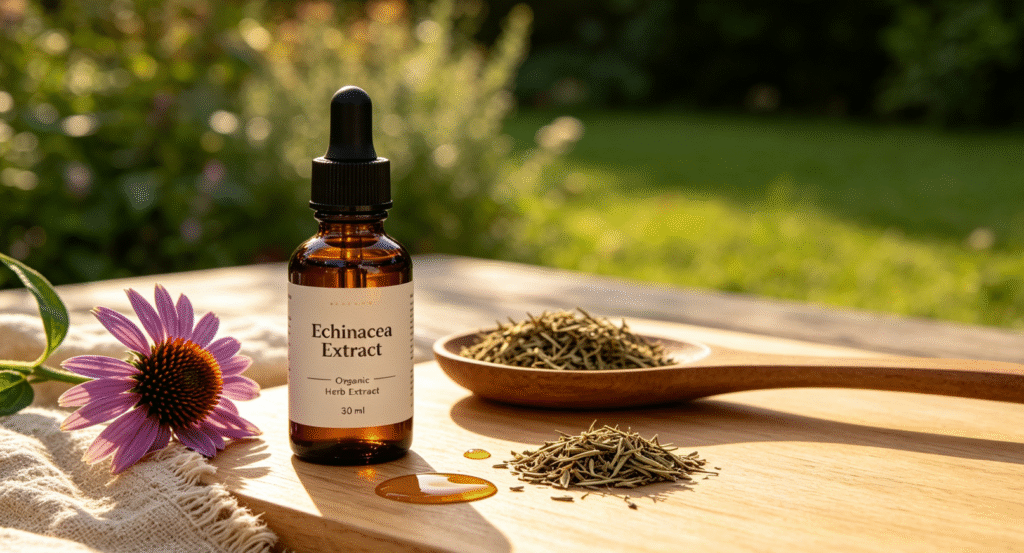
Echinacea Extract is a concentrated botanical ingredient derived from the aerial parts and roots of Echinacea purpurea (L.) Moench, a plant belonging to the Asteraceae family. The extract is valued for its naturally occurring bioactive compounds, including cichoric acid, caftaric acid, chlorogenic acid, and various alkylamides that serve as key quality markers.
In commercial production, Echinacea extract is available in multiple standardized forms. Common specifications include polyphenol content ranging from 4% to 80% (UV-verified) and cichoric acid content from 2% to 8% (HPLC-verified). The extract appears as a brown to yellowish-green fine powder, with extract ratios typically ranging from 4:1 to 8:1.
Core Specifications & Quality Grades
For professional buyers, understanding specifications is the first step to accurate procurement. The core specifications of Echinacea extract are determined by active marker content, purity, intended application, and extraction method.
Industry Standards – USP vs. Commercial Specifications
The United States Pharmacopeia (USP) sets the following standards for Powdered Echinacea purpurea Extract: a ratio of starting crude plant material to extract between 2:1 and 8:1, total phenols (caftaric acid, chicoric acid, and chlorogenic acid) not less than 4.0% on the dried basis, and dodecatetraenoic acid isobutylamides not less than 0.025% on the dried basis.
Commercial specifications typically range beyond USP minimums. Higher-purity extracts are available with polyphenols up to 80% and cichoric acid up to 8%, offering greater formulation flexibility and label claim potential. The cichoric acid content in high-quality products has increased from 4% in 2009 to 8% in present day.
Common Commercial Specifications
Standard commercial specifications typically include total polyphenols at 4.0% or higher, cichoric acid at 2.0% or higher (HPLC-verified), with extract ratios ranging from 4:1 to 8:1. Premium specifications offer total polyphenols up to 80.0%, cichoric acid from 4.0% to 8.0%, and higher extract ratios such as 10:1. Particle size typically ranges from 80 to 100 mesh, with loss on drying controlled to 5.0% or less. Heavy metal limits must meet international supplement standards, and microbiological quality must meet USP requirements.
Critical Quality Parameters
Marker standardization is essential for formulation consistency. Cichoric acid is commonly evaluated by HPLC when a specific compound result is required. The specification needs a target level, test method, reference standard, and calculation basis. Total polyphenols provide broader phenolic control but are often measured through UV-visible analysis, which does not separate individual compounds. Two suppliers reporting “4% polyphenols” may therefore be using different reference standards or calculations, making HPLC verification important for batch-to-batch consistency.
HPLC fingerprint testing evaluates several characteristic chromatographic peaks and can reveal profile changes associated with raw-material sourcing, processing, or species inconsistency. This test answers “does this batch resemble the material originally approved?” rather than simply “how much?”
Application-Specific Grades
Not all Echinacea extracts are the same. Depending on your application, you may need different grades. Standard extract at 4% polyphenols is best suited for capsules, tablets, and powder blends for dietary supplements. This is the most common specification and offers a balanced potency-to-cost ratio. High-polyphenol extract at 80% or higher is preferred for high-potency formulations and applications where antioxidant activity is the primary value proposition. Water-soluble grade has been developed for liquid applications such as beverages, functional drinks, and drops. These formulations achieve clear solutions with no precipitation or cloudiness, addressing historical challenges of Echinacea’s solubility in water-based systems.
Core Benefits of Echinacea Extract
Echinacea extract has been extensively studied for its wide-ranging biological effects, with findings derived from in vitro, animal, and clinical evidence.
For immune support, Echinacea is one of the most extensively researched botanical ingredients for immune function. Research demonstrates that Echinacea extracts can modulate immune responses through multiple mechanisms. Studies have shown that Echinacea extracts can suppress the infection and propagation of influenza viruses (H1N1, IVB) and respiratory syncytial virus (RSV-A), demonstrating potential as preventive and therapeutic agents for viral respiratory infections or as ingredients for health functional foods.
For anti-inflammatory support, research has documented that Echinacea extracts can inhibit mast cell activation, which is important for understanding its traditional use in treating inflammatory conditions. Alkylamides from Echinacea show potent activity as agonists of TRPV1, a pain receptor reported as an integrator of inflammatory pain.
For antioxidant protection, the high polyphenol content in Echinacea extract, particularly cichoric acid and other phenolic compounds, provides significant free radical scavenging activity. Studies have reported that high-polyphenol extracts exhibit stronger DPPH radical scavenging compared to conventional extracts.
For respiratory health, Echinacea preparations have been used primarily to treat upper respiratory infections. Native Americans used plants from the genus Echinacea to treat a variety of different inflammatory conditions including swollen gums, sore throats, and skin inflammation. A 2024 study suggested that Echinacea purpurea 60% ethanol extract can suppress viral infection, demonstrating potential as a preventive agent for viral respiratory infections.
Applications & Industrial Value
Echinacea extract is a versatile ingredient with applications spanning multiple industries.
In dietary supplements and nutraceuticals, Echinacea extract is most commonly used in immune support formulations. It is available in capsules, tablets, and powder sachets, with typical dosages ranging from 100 to 500 milligrams per serving of polyphenol-standardized extract. North America leads with nearly 38% of the global market share, driven by strong consumer demand for herbal supplements. It is often combined with vitamin C, zinc, or elderberry for synergistic immune blends.
In functional foods and beverages, Echinacea extract is used in teas, wellness shots, and fortified beverages. Water-soluble grades enable easy incorporation into instant drink mixes and liquid formulations. In China, approximately 34% of functional teas include Echinacea extract. The growing demand for clean-label botanical products is a key driver for this segment.
In cosmetics and personal care, Echinacea extract’s antioxidant and anti-inflammatory properties support its use in skin-protective and anti-aging formulations. The market includes sales of tinctures, teas, tablets, and topical formulations. Europe holds about 29% of the global market share, with Germany seeing nearly 49% of herbal medicine prescriptions include Echinacea extract.
In pharmaceutical applications, medical-grade Echinacea is used in medicines and medicinal products, representing the largest application segment. The pharmaceutical industry utilizes Echinacea extract in medicinal applications because of its documented medicinal properties.
Bioavailability & Formulation Considerations
One of the most common sourcing pitfalls is relying on ratio specifications alone. A ratio merely indicates the mass of raw plant material used to produce a unit of extract; it does not guarantee the concentration of active phytoconstituents and can exhibit significant batch-to-batch variance. For high-precision formulations, transitioning to a standardized specification based on cichoric acid or polyphenol content is essential.
A batch may pass its active-marker test but still create production problems. Important physical parameters include particle size, moisture, bulk density, flow, appearance, and dispersibility. A low-density extract may require a larger capsule, while moisture variation can contribute to caking, tablet sticking, or poor shelf stability.
For beverage applications, dispersible does not necessarily mean fully soluble. Natural botanical solids can create visible sediment in low-viscosity systems, making prototype testing essential before commercial approval.
Recent technological developments have successfully created water-soluble Echinacea extracts with clear solutions and no precipitation or cloudiness, providing an excellent solution for liquid Echinacea applications such as beverages and drops.
Regulatory & Safety Status
Echinacea extract is widely recognized as a safe dietary supplement ingredient in North America, Europe, and Asia. However, long-term use and high doses may cause overstimulation, allergic reactions, or drug interactions. Echinacea cultivation requires skilled labor and is a long-term investment process for manufacturing industries in terms of time and money.
For U.S. dietary supplement manufacturing, 21 CFR 111.70 requires component identity specifications, specifications necessary to ensure purity, strength and composition, and limits on relevant contamination. A responsible supplier should provide batch-specific COA documents confirming active marker content, heavy metals, pesticide residues, and microbiological safety.
Risk-based testing may include heavy metals, microbiological limits, pesticide residues, residual solvents, and other contaminants relevant to the botanical, process, and destination market.
Top suppliers include Jamieson Wellness Inc., Bioforce AG, Nutraceutical (Solaray), Xi’an Rainbow Biotech Co., Ltd, Shaanxi Jintai Biological Engineering Co., Ltd, Gonmisol, Ancient Green Fields, Gaia Herbs, Solgar Inc, Nature’s Bounty (Bountiful Co), and Jarrow Formulas.
Why Choose Our Echinacea Extract
As a professional botanical extract manufacturer, we offer high-quality, standardized Echinacea extract with multiple specification options including polyphenol-standardized grades (4% to 80% UV) and cichoric acid grades (2% to 8% HPLC). We provide water-soluble grades for beverage applications, organic certified grades with EU/USDA certification, and custom extraction ratios to match your formulation requirements. Our products offer full traceability with complete COA documentation including heavy metals, microbiological, and pesticide testing, and flexible supply from trial orders to full container shipments. We maintain GMP-certified production with ISO, Halal, and Kosher certifications available, and provide regulatory support with comprehensive documentation for global market submissions.
Ready to try for Echinacea Extract your business? Contact us at info@xianherb.com for a free sample or wholesale price list.


Leave A Comment