
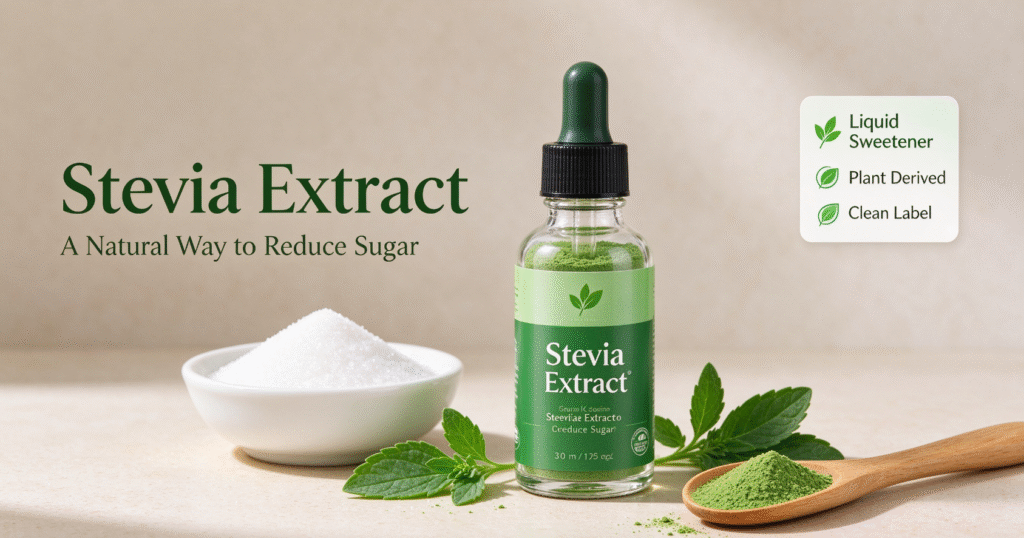
In the world of sugar reduction, most sweeteners make their name on a single proposition: replace sugar, cut calories, move on. Stevia extract is not one of them. This natural high-intensity sweetener, derived from the leaves of Stevia rebaudiana Bertoni, a plant native to South America, has been used by indigenous peoples for centuries to sweeten beverages and foods . But over the past two decades, modern food science and regulatory approval have transformed it from a regional curiosity into a globally recognized clean-label solution for beverage, dairy, bakery, and pharmaceutical applications.
For B2B buyers building zero-sugar or reduced-sugar formulations, stevia extract is an ingredient worth understanding in depth.
What Is Stevia Extract?
Stevia extract is a natural sweetener obtained from the leaves of Stevia rebaudiana through water extraction, resin purification, and spray drying . The sweetness comes from a family of compounds called steviol glycosides (SGs), which share a common steviol backbone but differ in their glycosylation patterns .
The two primary glycosides are stevioside (STV) and rebaudioside A (Reb-A). Commercial stevia extracts typically contain 90-98% total steviol glycosides, with Reb-A purity ranging from 40% to 98% depending on grade . These compounds are 200-350 times sweeter than sucrose, yet contribute zero calories and have no glycemic impact .
Beyond STV and Reb-A, newer minor glycosides — particularly Rebaudioside D (Reb-D) and Rebaudioside M (Reb-M) — have gained significant attention for their improved taste profiles. These compounds, while naturally present in only trace amounts, can now be produced through enzymatic conversion or fermentation .
Mechanism of Sweetness: Not Just a Sugar Substitute, but a Different Sensory Experience
Traditional sweeteners like sucrose deliver a rapid, clean sweetness onset followed by a quick finish. Stevia glycosides interact with sweet taste receptors differently, and understanding this difference is critical for successful formulation.
Sweet taste receptor activation. Steviol glycosides bind to the T1R2/T1R3 sweet taste receptors on the tongue, triggering a sweet signal without the metabolic consequences of sugar . However, the binding kinetics differ from sucrose, often resulting in a slower sweetness onset and a longer lingering sweetness .
Glycosylation and taste quality. The structural differences between glycosides directly influence sensory performance. Reb-A, while widely commercialized, is associated with residual bitterness and licorice-like aftertaste, particularly at higher concentrations . Reb-D and Reb-M, with additional glucose moieties, show significantly lower bitterness and a temporal profile closer to sucrose . This has driven the industry toward higher-purity Reb-A grades and next-generation Reb-M formulations.
Zero glycemic impact. Unlike sucrose, steviol glycosides are not metabolized into glucose. After consumption, gut bacteria hydrolyze them to steviol, which is absorbed and excreted primarily through urine . This makes stevia extract suitable for diabetic-friendly and glycemic-control products.
This “sweet but different” mode of action gives stevia unique potential — and unique formulation challenges.
Market and Regulatory Landscape: A Global Growth Story
Stevia extract is no longer a niche ingredient. The global market has expanded rapidly, driven by consumer demand for natural, clean-label, zero-calorie sweeteners and regulatory approvals across major jurisdictions.
Regulatory approval status. In the United States, stevia extracts containing a minimum of 95% Reb-A are generally recognized as safe (GRAS) by the FDA for use as a general-purpose sweetener . In the European Union, steviol glycosides (E 960) were approved as a food additive in 2011, with an Acceptable Daily Intake (ADI) of 4 mg/kg body weight (expressed as steviol) . The Joint FAO/WHO Expert Committee on Food Additives (JECFA) established the same ADI . China’s GB 2760-2024 standard permits steviol glycosides in a wide range of food categories, from flavored fermented milk to confectionery to beverages .
Market growth. The Asia-Pacific region holds a 31.05% share of the global stevia market, with China leading production and export . The powder format dominates, accounting for 94.78% of the market in 2025, favored for its stability, shelf life, and handling ease in large-scale manufacturing . The liquid format is the fastest-growing segment, projected to grow at a 12.31% CAGR from 2026 to 2031, driven by demand for zero-sugar beverages .
The China advantage. China accounts for 70-80% of global stevia extract production volume, benefiting from cost-effective leaf sourcing, established extraction infrastructure, and government support for agricultural processing . This concentration creates both opportunity and supply-chain risk for international buyers.
Product Specifications and Quality Control
As a B2B ingredient, the core value of stevia extract lies in glycoside composition, purity, and batch-to-batch consistency.
Typical specifications. Commercial grades are classified by total steviol glycoside content and Reb-A purity. Economy grades typically contain ≥90% total glycosides with 40-60% Reb-A, suitable for cost-sensitive applications. Mid-grade purified products contain ≥95% total glycosides with 80-95% Reb-A, offering a cleaner taste. Premium high-purity grades reach ≥98% total glycosides with 98% Reb-A, delivering a sucrose-like profile with minimal aftertaste .
Physical and chemical parameters. Stevia extract is a white to off-white free-flowing powder, freely soluble in water and ethanol. It exhibits excellent pH stability (3.0-10.0) and thermal stability, with no browning during high-temperature processing — a distinct advantage over sucrose in bakery and beverage sterilization . Heavy metal limits (Pb ≤1ppm, As ≤1ppm) comply with FCC and JECFA specifications .
Documentation support. For B2B buyers, complete documentation is essential: COA, MSDS, third-party test reports covering heavy metals, microbials, and residual solvents, as well as non-GMO and allergen statements where applicable.
Application Scenarios and Formulation Strategies
Zero-sugar beverages. The largest application category. Stevia extract is used in carbonated soft drinks, tea beverages, functional drinks, and flavored waters. The key challenge is bitterness and aftertaste management. Common strategies include blending with erythritol or allulose, adding organic acids (citric, malic) to mask bitterness, and selecting high-purity Reb-A or Reb-M grades .
Dairy products. Flavored fermented milk, yogurt, and ice cream can benefit from stevia’s zero glycemic impact and clean-label positioning. GB 2760-2024 permits up to 0.2 g/kg (as steviol equivalents) in flavored fermented milk .
Bakery and confectionery. Stevia’s thermal stability makes it suitable for baked goods and confectionery, though it lacks the bulking properties of sugar, requiring formulation adjustments with polyols or fibers.
Tabletop sweeteners and supplements. The most mature application. Stevia-based tabletop sweeteners and dietary supplement capsules are widely available, often blended with erythritol for improved mouthfeel and dissolution.
Beyond food: functional applications. Emerging research highlights stevia’s potential beyond sweetness. Steviol glycosides may exert prebiotic-like effects by selectively promoting beneficial gut bacteria such as Bifidobacteria and Lactobacilli . Stevia leaf residue, rich in chlorogenic acid, has shown promise as a functional feed additive for poultry and pigs, enhancing antioxidant capacity and intestinal health . These secondary applications add value across the supply chain.
Formulation Challenges and Solutions
If stevia has an “Achilles’ heel,” it is the taste gap between stevia sweetness and sucrose sweetness. The most common complaints are bitter aftertaste, licorice-like notes, and lingering sweetness.
The bitterness problem. Reb-A is the primary contributor to bitterness. Studies using descriptive sensory analysis have shown that Reb-A has significantly higher “in-mouth,” “immediate,” and “lingering” bitterness compared to Reb-D and Reb-M . The structural reason lies in the glycosylation pattern: Reb-D and Reb-M have additional glucose moieties that alter receptor binding and reduce activation of bitter taste receptors.
Grade selection matters. For premium zero-sugar beverages where taste is paramount, high-purity Reb-A (98%) or Reb-M grades are the preferred choice. For cost-sensitive applications where some aftertaste is acceptable, economy grades (90% total glycosides, 40-60% Reb-A) can deliver adequate sweetness at lower cost .
Blending strategies. Industrial practice has developed effective compound formulas:
-
Beverage standard: Steviol glycosides + citric acid / malic acid — balances sweetness peak and masks bitterness
-
Low-cost daily: Steviol glycosides + sucrose (1:80 ratio) — synergistic sweetness, reduces total sugar by 70%
-
Premium zero-sugar: Reb-A 98% + erythritol + amino acid compound — eliminates licorice taste, cold and clean sweetness
Enzymatic modification. For formulators seeking the closest match to sucrose, enzymatically modified stevia extracts enriched with Reb-M and Reb-D offer a taste profile nearly indistinguishable from sugar, with zero licorice aftertaste .
Safety and Regulatory Considerations
Steviol glycosides have been extensively evaluated by regulatory agencies worldwide. JECFA and EFSA have established an ADI of 4 mg/kg body weight (as steviol equivalents), corresponding to approximately 280 mg of steviol glycosides daily for a 70 kg adult . At typical usage levels in foods and beverages, intake remains well below the ADI.
Special population considerations. While steviol glycosides are generally well-tolerated, some individuals may experience digestive upset or allergic reactions (rare, primarily in those allergic to ragweed family plants) . People taking diabetes medications should monitor blood sugar, as stevia may enhance glucose-lowering effects .
Regulatory implications for B2B buyers. Regulatory status varies by market. In the EU, steviol glycosides are approved as a food additive (E 960) with specific usage categories and maximum levels . In China, GB 2760-2024 specifies permitted food categories and maximum usage levels . Product labels and claims should strictly comply with local regulations.
Why Choose Our Stevia Extract?
As a professional botanical extract supplier, we offer stevia extract products that meet B2B buyer requirements:
Multiple grades for diverse applications. From economy grades (≥90% total glycosides) for cost-sensitive applications to premium high-purity Reb-A (98%) and Reb-M enriched grades for taste-critical formulations, we provide specification options to match your formulation and budget.
Complete documentation support. Every shipment includes COA, MSDS, specification sheet, and third-party test reports covering heavy metals, microbials, and residual solvents.
Flexible supply. Minimum order quantities as low as 1 kg for trial orders, with scalable pricing for commercial volumes.
Technical support. Our team can provide formulation guidance on grade selection, blending strategies, and taste modification for your specific application.
Sustainable sourcing. Derived from renewable botanical resources with established and stable supply chains.
Stevia extract is not a trend ingredient — it is a plant-derived sweetener with decades of regulatory review, well-characterized sensory properties, and broad application prospects. For formulators building zero-sugar beverages, diabetic-friendly foods, or clean-label products, it deserves serious evaluation — but only with a clear understanding of its taste challenges and formulation strategies.
Ready to try Stevia Extract for your business? Contact us at info@xianherb.com for a free sample or wholesale price list.
Leave A Comment