
In the world of functional food ingredients, Phytosterols are a quiet yet substantial player. They may not have the overnight fame of certain trendy compounds, but decades of clinical research have built a remarkably solid evidence base for them. For consumers and formulators focused on cardiovascular health and lipid management, Phytosterols are a name that cannot be overlooked.
What Are Phytosterols?
Phytosterols are a class of naturally occurring steroidal compounds found in plants. Structurally, they closely resemble human cholesterol, with the key difference lying in subtle variations in the side chain. More than 250 types of phytosterols have been identified, with the most common being beta-sitosterol, campesterol, and stigmasterol.
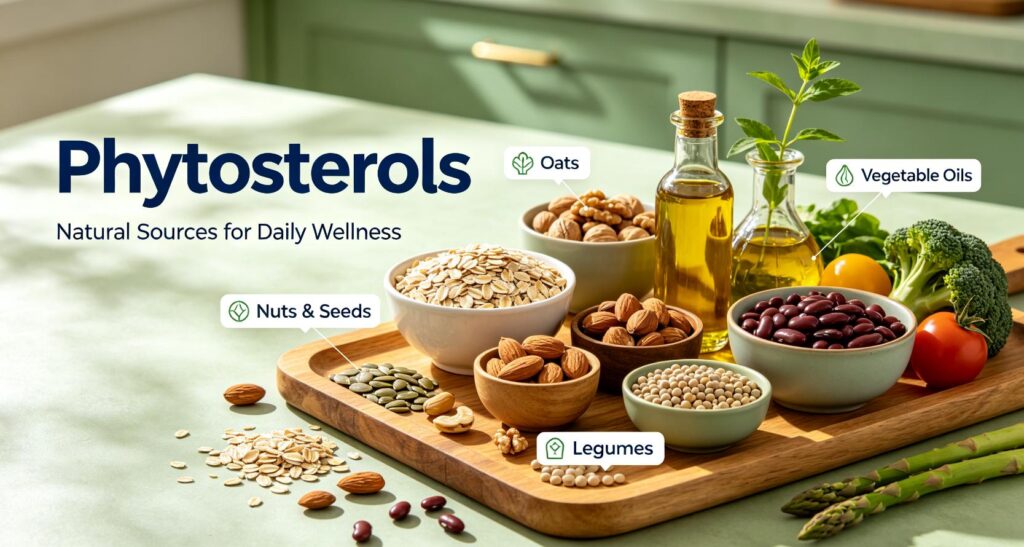
These compounds are widely distributed in vegetable oils, nuts, seeds, whole grains, and legumes, with vegetable oils being particularly rich sources. However, the amount of phytosterols obtained through a typical diet is usually limited. To reach clinically meaningful doses, fortification or dietary supplementation is often necessary.
How Do They Work?
The core mechanism of phytosterols can be summed up in one word: competition.
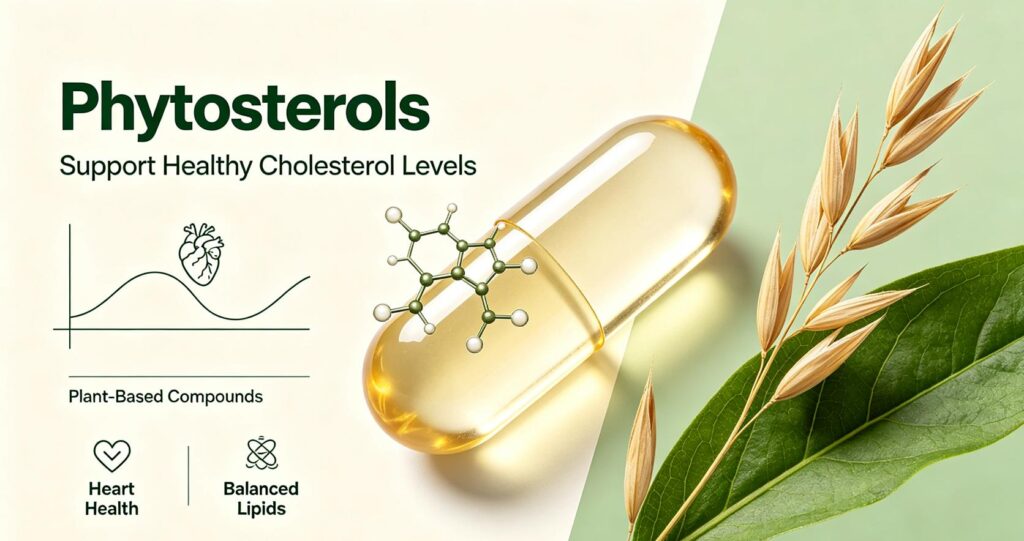
Because phytosterols are structurally very similar to cholesterol, they compete in the intestine—vying with cholesterol for absorption opportunities. When phytosterols occupy the intestinal cell absorption channels, a portion of cholesterol cannot enter the bloodstream and is instead excreted in feces. The result of this competitive inhibition is less cholesterol entering circulation, particularly a reduction in low-density lipoprotein cholesterol (LDL-C, the “bad cholesterol”).
A consensus document published in the European Heart Journal states that a daily intake of approximately 2 grams of phytosterols can reduce LDL-C levels by 8% to 10%. Clinical information from the Cleveland Clinic corroborates this data. Notably, the lipid-lowering effect of phytosterols is additive with statin medications. The consensus panel of the European Atherosclerosis Society considers phytosterol-fortified foods a viable adjunct for patients who have not reached target levels on statins or who cannot tolerate them.
More Than Just Cholesterol Lowering
While cholesterol reduction is the most widely recognized function of phytosterols, research suggests their effects may extend further.
Multiple studies indicate that phytosterols possess certain anti-inflammatory and antioxidant activities. A 2025 review published in Trends in Food Science & Technology noted that the health-promoting effects of phytosterols include cholesterol-lowering, anti-inflammatory, and antioxidant effects. A study on hypercholesterolemic patients also explored the effects of phytosterol supplementation on low-grade inflammation, endothelial function, and oxidative stress markers.
Cleveland Clinic materials mention that early research suggests diets rich in phytosterols may reduce cancer risk by up to 20%. However, this area still requires more clinical research for confirmation.
Phytosterols also have high permeability for the skin and can help maintain skin surface moisture, promote skin metabolism, and inhibit skin inflammation, giving them value in cosmetic applications. In some formulations, phytosterols are also used as natural emulsifiers and texture modifiers.
Product Specifications and Quality Control
As a B2B ingredient, the quality and specifications of phytosterols directly affect the efficacy and compliance of end products. Our phytosterol products are standardized to a total phytosterol content of at least 95%, with beta-sitosterol typically ranging from 40% to 50%, campesterol from 20% to 30%, and stigmasterol from 15% to 25%. The product appears as a white to off-white powder with a loss on drying of no more than 3% and ash content below 0.5%. Heavy metals and pesticide residues meet USP, FCC, and EU standards.
The product is extracted from vegetable oils such as soybean oil using a non-GMO process, ensuring a sustainable source and consistent quality.
Application Scenarios
The applications of phytosterols go far beyond traditional cholesterol-lowering margarine. Thanks to their good stability and neutral flavor, they can be incorporated into various food matrices.
In spreadable fats such as margarine and butter blends, addition levels typically range from 8% to 14%, remaining stable during processing without affecting flavor. In dairy products like yogurt and milk, addition levels of 1% to 3% do not affect taste or texture. In beverages such as juice and plant-based milk, addition levels of 0.5% to 2.0% are common, usually used with emulsifiers to ensure dispersion.
For dietary supplements, phytosterols are commonly used in tablets and capsules at typical dosages of 800 to 2,000 milligrams per serving, and can also be added to powder packs or bulk powders. In baked goods such as bread, cereals, and snacks, addition levels of 2% to 5% are typical, while emulsified sauces and dressings may contain 1% to 3%.
For beverages and transparent systems, microencapsulated or water-dispersible phytosterols are more suitable options. These products improve the dispersibility of phytosterols in aqueous phases through special processes, broadening application boundaries.
Safety and Precautions
Phytosterols are safe for most healthy individuals, do not accumulate in the body, and do not affect the absorption of fat-soluble vitamins A, D, E, and K.
There is one important exception: sitosterolemia patients. This is a rare genetic disorder in which patients have abnormally elevated phytosterol levels, potentially increasing the risk of premature atherosclerosis. This population should avoid phytosterol supplementation. Additionally, phytosterols cannot replace prescription lipid-lowering medications. Consumers using phytosterol-containing supplements should understand their positioning as an adjunctive approach.
Why Choose Our Phytosterols?
As a professional botanical extract supplier, our phytosterols offer high-purity standardization with total sterol content of at least 95%, clearly defined major component ratios, and guaranteed batch-to-batch consistency. We provide complete documentation support including COA, MSDS, and third-party test reports covering heavy metals, microbials, residual solvents, and other key indicators. We support flexible supply with minimum order quantities as low as 1 kilogram for small trial orders and large-scale procurement. Custom specifications such as water-dispersible grades are available upon request.
The value of phytosterols lies in the fact that they have stood the test of time. They are not a trend-chasing ingredient, but rather a steady raw material backed by clinical data, recognized by regulatory systems, and supported by mature application scenarios. If your product line involves cardiovascular health, lipid management, or functional foods, phytosterols deserve serious consideration.
Ready to try Phytosterols for your business? Contact us at info@xianherb.com for a free sample or wholesale price list.
Leave A Comment