
Global formulators and bulk buyers frequently ask what makes Soybean Extract a must-have ingredient for commercial production. The answer lies in its unique isoflavone profile—particularly daidzein, genistein, and glycitein—which has made it one of the most studied and commercially successful botanical ingredients for women’s health, cardiovascular wellness, and functional food applications.
What Is Soybean Extract?
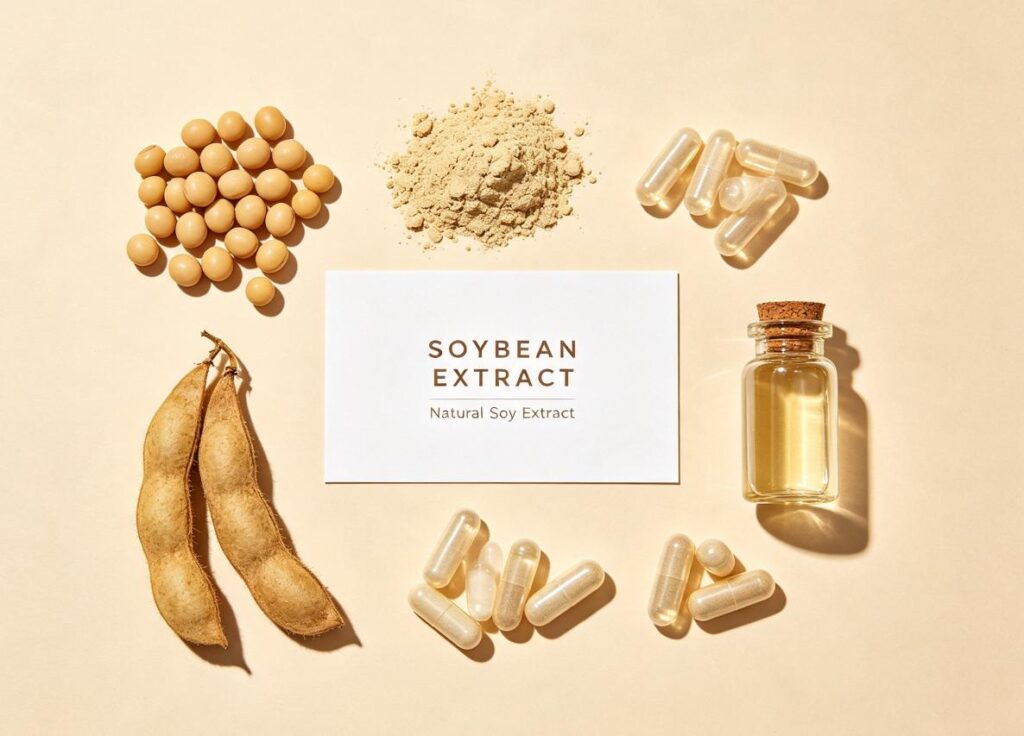
Soybean Extract is a concentrated botanical ingredient derived from the seeds of Glycine max (L.) Merr., a legume native to East Asia that has been cultivated for thousands of years. The extract is valued for its naturally occurring isoflavones—a class of phytoestrogens that structurally resemble 17-β-estradiol and have been extensively studied for their biochemical interactions .
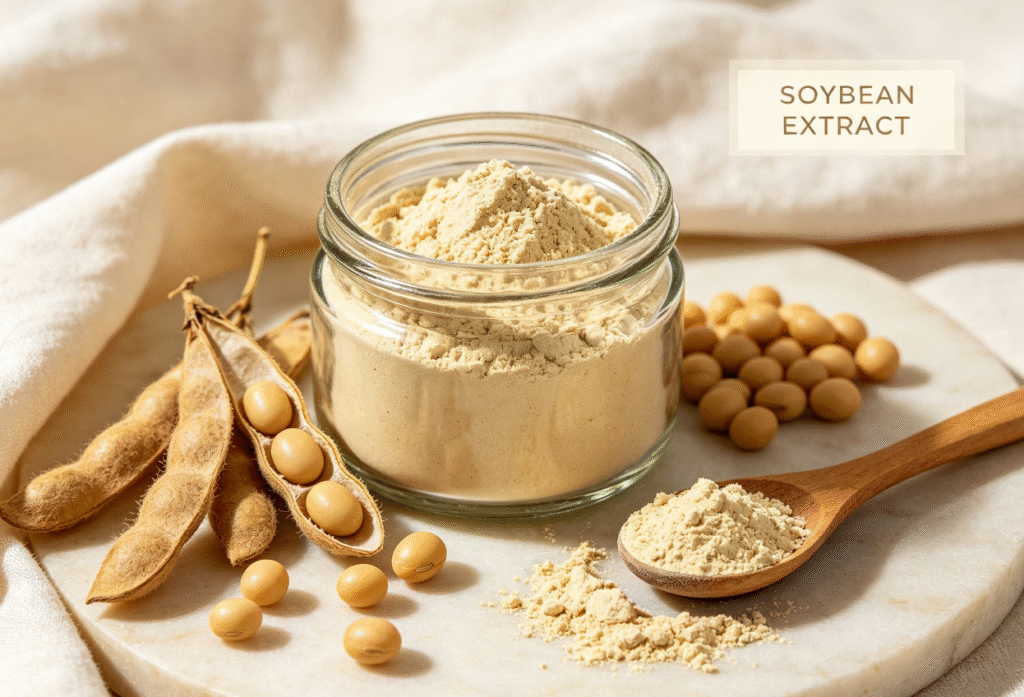
In commercial production, soybean extract is available in multiple standardized forms, most commonly based on either isoflavone content or saponin content. The extract appears as a yellowish-brown to off-white powder, with specifications ranging from 5% to 90% total isoflavones (HPLC-verified). The germ fraction of the soybean is particularly prized, containing higher concentrations of isoflavones compared to the cotyledon .
Core Specifications & Quality Grades
For professional buyers, understanding specifications is the first step to accurate procurement. The core specifications of soybean extract are determined by isoflavone content, purity, and intended application.
Isoflavone Standardization – The Industry Benchmark
The key bioactive markers are the four principal isoflavones: daidzein, genistein, glycitein, and their respective glycosides (daidzin, genistin, glycitin). Premium extracts are standardized to 40% to 50% total isoflavones by HPLC, with the 40% grade being the most common specification for dietary supplements .
A high-quality specification sheet should clearly state the individual isoflavone profile. For example, a typical 40% isoflavone extract may contain total genistin and genistein content accounting for 55-72% of the total isoflavones, with the balance comprising daidzein and glycitein fractions . For higher-purity cosmetic applications, extracts standardized to 50% total identified isoflavones with specific daidzein and genistein content minimums of 25% each are available .
Soybean Germ Extract vs. Whole Soy Extract
From a procurement and formulation standpoint, soybean germ extract offers several distinct advantages over whole soy extract. The germ fraction contains naturally higher isoflavone density, resulting in a cleaner flavor profile, easier standardization, and more precise dosage control compared to whole soy extract . For international brands, this translates into better batch consistency, easier regulatory documentation, and smoother scale-up.
Application-Specific Grades
Lower-grade extracts at 5% to 20% total isoflavones are typically selected for functional foods, beverages, and daily nutrition products where the goal is to maintain a moderate isoflavone background without dominating the taste profile. The 40% grade is the workhorse for conventional dietary supplements, capsules, and tablets, offering a balanced potency-to-cost ratio. High-potency formulations and pharmaceutical applications generally require the 40% to 90% grade, where formulation precision and consistent active intake are critical .
Critical Quality Parameters
When sourcing soybean extract, the most critical procurement parameter is total isoflavone content with clear HPLC method disclosure. A COA that only states “Isoflavones 40%” without specifying the analytical method should be treated as incomplete for procurement-grade approval . The assay basis—whether calculated as aglycones (free forms) or glycosides—must be clearly stated to ensure comparability across batches and suppliers .
Loss on drying should be controlled to 5.0% or less to prevent moisture-induced degradation and microbial growth during shelf life. Heavy metal limits must meet international supplement safety standards, with lead, arsenic, cadmium, and mercury strictly controlled . Particle size should ensure at least 95% through 80 mesh to guarantee flowability and blend uniformity in capsule and tableting lines. Microbiological limits, including total plate count, yeasts and molds, and absence of E. coli, Salmonella, and Pseudomonas aeruginosa, ensure safety without over-processing that might degrade heat-sensitive isoflavones .
Fingerprint Requirements
Fingerprinting protects you from “same number, different profile.” A buyer-friendly fingerprint package for Soybean Extract should include a reference chromatogram (golden batch) and a current-lot chromatogram, retention time windows for major peaks, acceptance criteria (similarity index or peak ratio bands), and system suitability rules to keep fingerprints comparable . When beverage performance matters, consider adding a simple in-house functional check as a secondary release criterion.
Allergen and Compliance Considerations
Critical Alert for Buyers: In the U.S., FDA guidance for industry explicitly includes soybeans among major food allergens that must be declared on labels for FDA-regulated foods. In the EU/UK context, soybeans and products thereof appear in Annex II (substances causing allergies or intolerances) of Regulation (EU) No 1169/2011 .
Procurement tip: Even when an ingredient is soy-derived, labeling obligations can depend on residual protein and category rules. QA teams commonly request an allergen statement plus supporting rationale/testing where relevant . When developing formulations with soybean extract, best practice is conservative inclusion, sensory evaluation in the final matrix, and stability trials that include foam and dispersibility checks, as saponins’ surfactant-like behavior can contribute to GI discomfort in some individuals at higher exposures .
Applications & Industrial Value
Soybean extract is a versatile ingredient with applications spanning multiple industries:
Dietary Supplements & Nutraceuticals
Soybean extract is most commonly used in women’s health, menopausal support, and cardiovascular wellness formulations. It is available in capsules, tablets, and powder sachets, with typical standardized dosages ranging from 35 to 80 mg per day of isoflavones expressed as genistein . It is often combined with other wellness-support ingredients for synergistic blends.
Functional Foods & Beverages
Soybean extract is used in nutrition bars, fortified beverages, plant-based dairy alternatives, and functional foods. Water-dispersible grades enable easy incorporation into dry premixes and instant drink mixes, with typical usage levels ranging from 0.5% to 2.0% of the formulation depending on the desired isoflavone content.
Cosmetics & Personal Care
Soybean extract’s antioxidant and phytoestrogen properties support its use in anti-aging serums, moisturizers, and skincare formulations targeting skin elasticity and hormonal skin changes. Cosmeceutical-grade extracts standardized to 50% total isoflavones with specific daidzein and genistein content requirements are available for beauty-from-within concepts and topical applications .
Pharmaceutical Applications
Soybean extract is used as an API for nutraceutical applications, with manufacturers offering products compliant with USP, EP, and other pharmacopoeial standards . The extract has been the subject of extensive research, with studies documenting rapid disintegration kinetics for nutraceuticals intended for menopausal and cardiovascular applications .
Supplier Selection & Quality Considerations
When sourcing soybean extract, verify that the product meets recognized standards. Botanical identity must be confirmed as Glycine max with the specific part used (germ or whole soybean) clearly stated. Isoflavone profile should be verified by HPLC for all four isoflavones—daidzein, genistein, glycitein, and their respective glycosides—not just total content.
Standardization grade should be clearly stated with batch-specific COA documentation. Manufacturing certifications including GMP, ISO, HACCP, Halal, and Kosher should be available. A reliable soybean germ extract manufacturer should offer controlled raw material sourcing, food-grade or pharmaceutical-grade extraction, HPLC-based isoflavone analysis, batch-to-batch consistency, and full traceability documentation .
Heavy metal limits should meet international standards. Microbiological quality should show absence of pathogens. Pesticide residues should meet international standards for dietary supplements, and particle size should ensure formulation compatibility .
Why Choose Our Soybean Extract
As a professional botanical extract manufacturer, we offer high-quality, standardized soybean extract with multiple specification options including 40% and 50% total isoflavone grades verified by HPLC. We provide full isoflavone profile verification of all markers with water-dispersible grade available for beverage and functional food applications. Our products offer full traceability with complete COA documentation including heavy metals, microbiological, and pesticide testing, and flexible supply from trial orders to full container shipments. We maintain GMP-certified production with ISO, Halal, and Kosher certifications available.
Ready to try Soybean Extract for your business? Contact us at info@xianherb.com for a free sample or wholesale price list.
Leave A Comment