
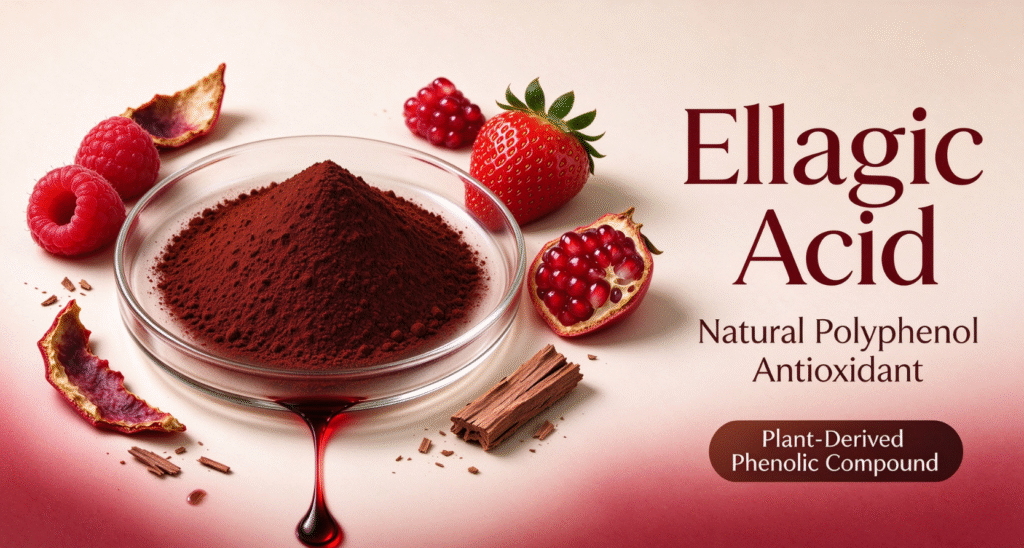
In the rapidly expanding world of plant-based antioxidants, few compounds embody the convergence of traditional botanical wisdom and cutting-edge nutraceutical science as compellingly as ellagic acid. As a naturally occurring polyphenol found abundantly in pomegranates, berries, and certain nuts, this versatile compound has transitioned from a subject of academic investigation to a commercially significant ingredient in the global health, nutrition, and personal care markets. For formulators, supplement brands, and B2B buyers seeking evidence-backed natural solutions for oxidative stress management, metabolic health, and healthy aging, ellagic acid offers a rare combination: a well-characterized antioxidant mechanism, a growing body of clinical research, and a supply chain deeply rooted in Asia-Pacific botanical extraction capabilities .
What Is Ellagic Acid?
Ellagic acid (C₁₄H₆O₈) is a naturally occurring phenolic compound classified as a dilactone of hexahydroxydiphenic acid. It exists in plants primarily in the form of ellagitannins—complex polyphenols that release ellagic acid upon hydrolysis . The compound was first discovered by chemist Henri Braconnot in 1831, but it has only been in recent decades that its full commercial and therapeutic potential has begun to be systematically explored.
From a chemical perspective, ellagic acid is a white to beige crystalline powder with a molecular weight of approximately 302.20 g/mol and a CAS number of 476-66-4 . It is practically insoluble in water but soluble in ethanol and dimethyl sulfoxide, a characteristic with significant implications for formulation and bioavailability. The compound is most abundantly sourced from pomegranate peel (Punica granatum), which contains substantially higher concentrations than the fruit pulp, as well as from raspberries, strawberries, blackberries, walnuts, and certain oak species .
Commercial ellagic acid products are typically offered as high-purity extracts (≥98% by HPLC) for pharmaceutical and research applications, or as standardized pomegranate extracts (typically 40% ellagic acid content) for cost-sensitive nutraceutical and cosmetic formulations . The compound is also available in water-soluble formulations for applications requiring enhanced bioavailability.
Mechanism of Action: A Multi-Target Antioxidant
Unlike synthetic antioxidants that often target a single reactive oxygen species, ellagic acid exerts its biological effects through a network of interconnected pathways. This multi-target profile is critical for formulators developing products for oxidative stress management, metabolic support, and neuroprotection.
Direct radical scavenging and antioxidant enzyme modulation. Ellagic acid possesses potent free radical scavenging activity, directly neutralizing reactive oxygen species (ROS) and reactive nitrogen species. Beyond direct scavenging, it enhances endogenous antioxidant defenses by upregulating key enzymes including superoxide dismutase (SOD), catalase, and glutathione peroxidase . This dual mechanism—scavenging existing radicals while fortifying cellular defense systems—provides comprehensive oxidative stress protection.
Anti-inflammatory pathway modulation. Ellagic acid inhibits the activation of microglia and astrocytes, reducing the production of proinflammatory cytokines such as TNF-α and IL-6 . It modulates key inflammatory signaling cascades including NF-κB, Nrf2, and MAPK pathways, which are central to the pathogenesis of chronic inflammatory conditions . This anti-inflammatory activity complements its antioxidant effects, addressing the bidirectional relationship between oxidative stress and inflammation.
Metabolic regulation via PPARγ modulation. Recent research has identified ellagic acid as a modulator of peroxisome proliferator-activated receptor gamma (PPARγ), a nuclear receptor critical for lipid metabolism and insulin sensitivity. Molecular docking studies demonstrate that ellagic acid stably binds to PPARγ and functions as an antagonist, suppressing its nuclear translocation and transcriptional activity . This mechanism underlies its observed lipid-lowering effects and positions ellagic acid as a promising ingredient for metabolic health formulations.
Mitochondrial protection. Ellagic acid has demonstrated the ability to preserve mitochondrial function by reducing ROS levels, maintaining mitochondrial membrane potential, and restoring ATP production. These effects are particularly relevant to neuroprotection, as mitochondrial dysfunction is increasingly recognized as a key driver of neurodegenerative pathology .
Clinical Evidence: What the Research Shows
For B2B buyers evaluating ellagic acid for product development, understanding the clinical evidence base is essential for accurate positioning and compliant claim substantiation.
Non-alcoholic fatty liver disease (NAFLD). A randomized, double-blind, placebo-controlled clinical trial involving 44 patients with NAFLD found that supplementation with 180 mg of ellagic acid daily for 8 weeks significantly reduced insulin resistance, triglycerides, LDL cholesterol, liver enzymes (AST, ALT, ALP, GGT), malondialdehyde (a marker of oxidative stress), and C-reactive protein (an inflammatory marker) compared to placebo. Total antioxidant capacity was significantly increased in the intervention group . These findings provide robust clinical support for ellagic acid in metabolic health applications.
Hyperlipidemia and cardiovascular markers. Preclinical studies in hyperlipidemia mouse and zebrafish models demonstrated that ellagic acid effectively alleviates lipid accumulation and significantly reduces inflammatory response by lowering serum levels of TNF-α and IL-6 . These results suggest potential cardiovascular benefits that warrant further investigation in human trials.
Neurodegenerative disease support. A comprehensive review of ellagic acid’s clinical and mechanistic properties for neurodegenerative diseases highlights its antioxidant, antiapoptotic, and anti-inflammatory activities that support neuroprotective effects. The review notes improvements in neuroinflammation reduction, cognitive function enhancement, and overall neuroprotection, while recommending further clinical research to solidify the evidence base . Animal studies have demonstrated that ellagic acid at higher doses (50 and 100 mg/kg) effectively restores mitochondrial function in Alzheimer‘s disease models by attenuating oxidative stress, maintaining membrane potential, and enhancing ATP production .
Regulatory Landscape: Key Considerations for B2B Buyers
Ellagic acid is regulated differently across major markets, with implications for product labeling and claim substantiation.
United States. Ellagic acid is regulated as a dietary supplement ingredient when used in supplement formulations. Structure/function claims related to antioxidant protection and oxidative stress management are permissible with appropriate substantiation. However, the FDA has identified ellagic acid as a “fake cancer ‘cure‘ consumers should avoid” when marketed with unsubstantiated disease treatment claims . Brands should exercise caution to ensure all claims are consistent with FDA regulations for dietary supplements.
Europe. Ellagic acid and pomegranate extracts containing ellagic acid are used in food supplements and cosmetic products across EU member states. Cosmetic claims must comply with the EU Cosmetics Regulation, while supplement claims must adhere to the EU Health Claims Regulation. Products containing ellagic acid intended for specific health applications typically carry specific labeling requirements.
China. Pomegranate peel extract standardized to ellagic acid content is regulated as a functional food ingredient. Products must declare the ellagic acid content individually, and manufacturers must comply with relevant national standards for botanical extracts. The recommended daily intake varies by product registration category.
Market Landscape: A Growing Global Opportunity
The global ellagic acid market was valued at approximately USD 83.44 million in 2025 and is projected to reach USD 131.79 million by 2034, expanding at a CAGR of approximately 5.21% . Other market analyses project growth from USD 18.72 million to reach USD 18.72 million by 2032 at a CAGR of 6.2%, reflecting the growing demand across multiple application segments .
Regional dynamics. China dominates the ellagic acid market with approximately 43% of global consumption, supported by large-scale pomegranate cultivation and established botanical extraction infrastructure. The Asia-Pacific region remains the largest production center, with major manufacturers including Shaanxi Huike Botanical Development, Hunan Nutramax, and Xi‘an Lyphar Biotech supplying the global market . North America and Europe represent significant demand centers, driven by the dietary supplement and clean beauty trends.
Application segments. The market is segmented into three primary application categories with distinct growth trajectories :
-
Nutraceuticals and dietary supplements (estimated share: 75%): The largest application segment, driven by growing consumer demand for natural antioxidants. Demand-side indicators include the expansion of the global dietary supplements market and the increasing popularity of pomegranate and berry extracts as superfood ingredients.
-
Cosmeceuticals and personal care (estimated share: 15%): Driven by ellagic acid’s antioxidant and anti-inflammatory properties valued in anti-aging creams, serums, and skin health formulations. The segment is growing at a CAGR of 9%, supported by the clean beauty trend favoring natural ingredients .
-
Research and development (estimated share: 10%): Characterized by demand for high-purity grades (≥98% assay) and small-volume purchases. Academic and industrial research labs use ellagic acid as a reference standard and research tool in cell-based assays and animal models .
Product form trends. Standardized pomegranate extracts (typically 40% ellagic acid) account for the majority of commercial volume, offering an optimal balance of potency, stability, and cost-effectiveness. High-purity ellagic acid (≥98%) serves pharmaceutical and research applications. Powdered forms dominate, driven by superior stability, extended shelf life, and versatility across multiple formulation formats including capsules, tablets, and functional foods.
Consumer trends. The growing interest in natural antioxidants, “clean label” ingredient sourcing, and preventive health approaches continues to drive demand for ellagic acid. Its established presence in traditional pomegranate-based remedies and its GRAS-adjacent regulatory status in key markets make it particularly attractive for brands targeting oxidative stress management, metabolic health, and healthy aging demographics.
Product Specifications and Quality Control
As a B2B ingredient, the value of ellagic acid lies in purity standardization, batch-to-batch consistency, and contaminant control.
Typical specifications. High-purity ellagic acid is available at ≥98% (HPLC) for pharmaceutical and research applications. Standardized pomegranate extracts typically contain 40% ellagic acid, with the balance consisting of other pomegranate polyphenols and plant matrix components . The product is typically an off-white to beige fine powder, soluble in ethanol and dimethyl sulfoxide, and practically insoluble in water.
Quality control considerations. Inconsistent ellagic acid content between batches is a common challenge in botanical extract sourcing. Best practices include rigorous HPLC-based quantification of ellagic acid, not just total polyphenol content. Third-party testing for heavy metals (lead, arsenic, mercury, cadmium), microbials, pesticide residues, and residual solvents is essential. Non-GMO and allergen statements are increasingly required by brand customers.
Documentation support. Complete documentation includes Certificate of Analysis (COA), Material Safety Data Sheet (MSDS), specification sheet, and third-party test reports. For products targeting regulated markets, additional documentation may include GMP certificates, ISO certifications, and organic certifications where applicable.
Why Choose Xi‘an Herb Bio-Tech Ellagic Acid?
As a professional botanical extract supplier, Xi’an Herb Bio-Tech Co., Ltd offers ellagic acid and pomegranate extract products that meet the rigorous requirements of B2B buyers:
Multiple grades for diverse applications. From high-purity ellagic acid (≥98%) for pharmaceutical and research applications to standardized pomegranate extracts (40% ellagic acid) for cost-sensitive nutraceutical and cosmetic formulations, we provide specification options to match your formulation and budget requirements.
Complete documentation support. Every shipment includes COA, MSDS, specification sheet, and third-party test reports covering heavy metals, microbials, and residual solvents. Our quality control processes are aligned with standard analytical methods for polyphenol quantification.
Flexible supply. Minimum order quantities as low as 1 kg for trial orders, with scalable pricing for commercial volumes. We support custom packaging and labeling to meet your brand requirements.
Stable supply chain. Leveraging our established network of pomegranate cultivation partners and our own production capabilities, we ensure consistent availability and batch-to-batch reproducibility—critical for brands maintaining product quality across production runs.
Ready to try Ellagic Acid for your business? Contact us at info@xianherb.com for a free sample or wholesale price list.
Leave A Comment