
Global formulators and bulk buyers frequently ask what makes Lycopene a must-have ingredient for commercial production. The answer lies in its exceptional antioxidant capacity—it is the most potent singlet oxygen quencher among all carotenoids, with a quenching ability twice that of beta-carotene and tenfold that of alpha-tocopherol . As a natural red pigment with scientifically validated biological activities, lycopene has become one of the most sought-after ingredients across the dietary supplement, functional food, beverage, cosmetic, and pet nutrition industries.
What Is Lycopene?
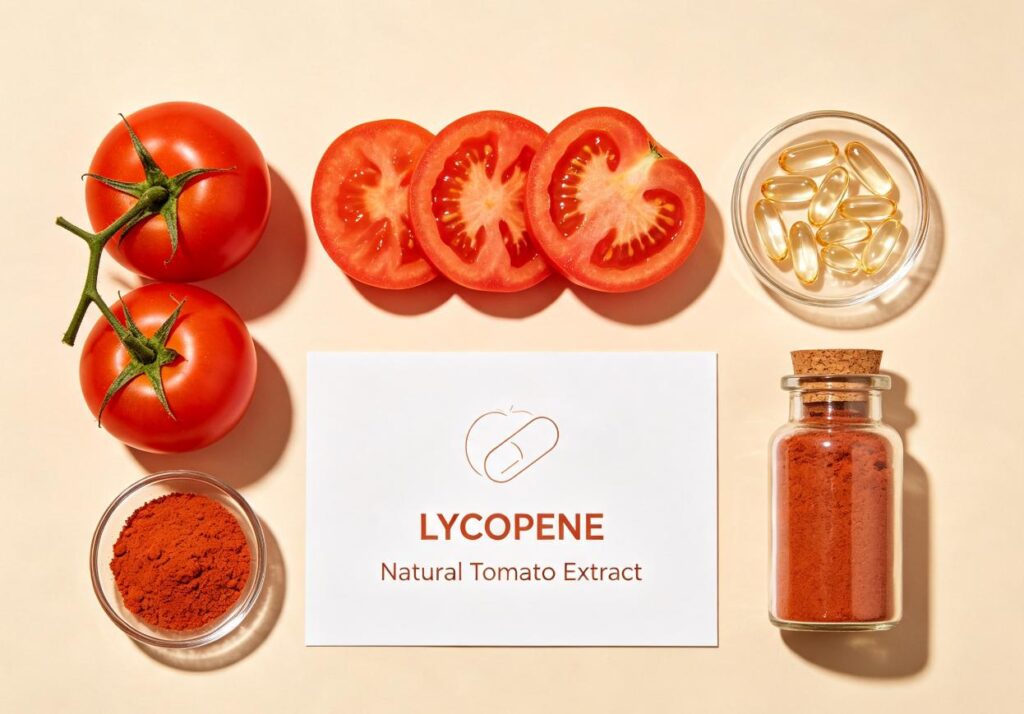
Lycopene is a lipid-soluble tetraterpenoid carotenoid responsible for the red color in various fruits and vegetables, primarily tomatoes, watermelon, pink grapefruit, and papaya . Its chemical formula is C₄₀H₅₆ with a molecular weight of 536.87 g/mol and a CAS number of 502-65-8.
Humans cannot synthesize lycopene and must obtain it through diet or supplementation. The average daily intake in Western populations ranges from 5 to 7 milligrams per day. In the human body, lycopene accumulates in the liver, adipose tissue, adrenal glands, and prostate gland. The liver concentration ranges from 1.28 to 25.46 nanomoles per gram, while plasma concentration ranges from 0.22 to 1.06 nanomoles per milliliter.
Tomatoes are the cheapest and most abundant source of lycopene, providing approximately 80% of total lycopene in the human diet. Tomato-based products including ketchup, tomato paste, soups, and sauces also contain significant amounts. Other commercial sources include red watermelon, pink guava, and papaya. For industrial production, lycopene is also extracted from the fungus Blakeslea trispora, which offers advantages for consistent, scalable manufacturing.+
Core Specifications & Quality Grades
For professional buyers, understanding specifications is the first step to accurate procurement. Lycopene is available in multiple purity grades, with specifications ranging from 5% to 98% purity verified by HPLC testing.
Purity grades available include 5% to 20% products, which are typically oil suspensions or beadlets for food color and fortification applications. The 20% to 50% powder grades are suitable for dietary supplements and functional foods. High-purity crystalline powder grades of 90% or higher are used for pharmaceutical and premium nutraceutical applications.
The product appears as a dark red to reddish-brown crystalline powder, with its botanical source primarily being tomato, though watermelon, pink guava, and papaya are also used as sources. The part used is the ripe fruit. A high-quality specification sheet should clearly state the purity grade and HPLC assay method used. Professional buyers should request batch-specific COA documentation confirming purity, heavy metals, and microbiological safety.+
Bioavailability Challenges & Advanced Delivery Systems
One of the most critical considerations for procurement is bioavailability. Lycopene is highly lipophilic and has poor water solubility, which limits its oral absorption and stability. Natural lycopene in raw tomatoes is present as crystalline needles that can precipitate in aqueous environments, further reducing bioavailability.
To overcome these challenges, innovative delivery systems have been developed. Microencapsulation encapsulates lycopene to protect against degradation, improve water dispersibility, and enhance stability, with leading suppliers offering microencapsulated lycopene in beadlet and powder forms.
Nanoparticle carriers, including polymeric micelles, lipid nanoparticles, and nanostructured lipid carriers, have been shown to significantly improve aqueous solubility, prevent isomerization, and enhance intestinal absorption and oral bioavailability. Micellar formulations protect lycopene from photodegradation, with studies showing that approximately 50% of free lycopene degrades after 5 minutes of UV exposure, while micellar formulations experience only 2% degradation under the same conditions.
Liposomes have demonstrated potential for improving therapeutic efficacy and bioavailability, with encapsulation efficiency reaching 82%. Nanoemulsions achieve maximum encapsulation efficiency of 67% with a 1:2 Gt to Cas ratio, significantly enhancing lycopene release to over 80% within 24 hours. Solid dispersion formulations with polyvinylpyrrolidone enhance aqueous solubility and release rates, with studies demonstrating 68.18% release within 24 hours.
Leave A Comment