
Global formulators and bulk buyers frequently ask what makes Red Clover Extract a must-have ingredient for commercial production. The answer lies in its unique isoflavone profile—biochanin A, formononetin, daidzein, and genistein—which has made it one of the most extensively researched botanical ingredients for women’s health, menopausal support, and cardiovascular wellness formulations. With the global market continuing to expand across nutraceutical, functional food, and cosmetic applications, demand for high-quality, standardized red clover extract is growing steadily .
What Is Red Clover Extract?
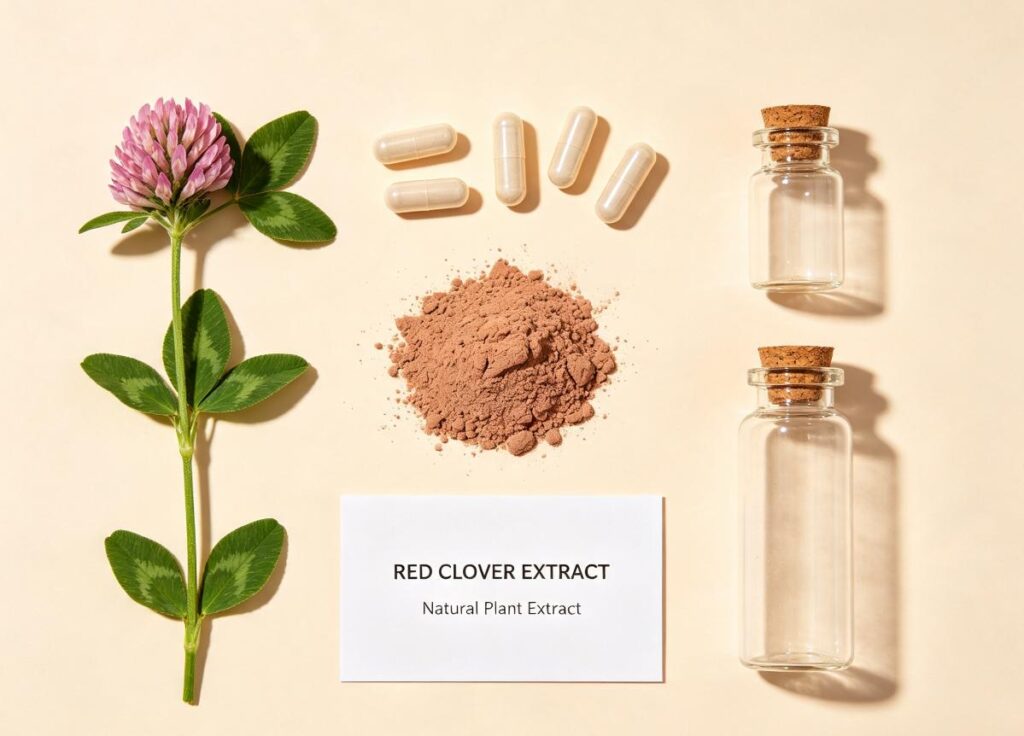
Red Clover Extract is a concentrated botanical ingredient derived from the flowering tops of Trifolium pratense L., a plant native to Europe, Asia, and North America that has been used in traditional herbal medicine for centuries. The extract is valued for its naturally occurring isoflavones—a class of phytoestrogens that structurally resemble 17-β-estradiol and exhibit selective estrogen receptor modulator (SERM) activity, with preferential affinity for ERβ receptors.
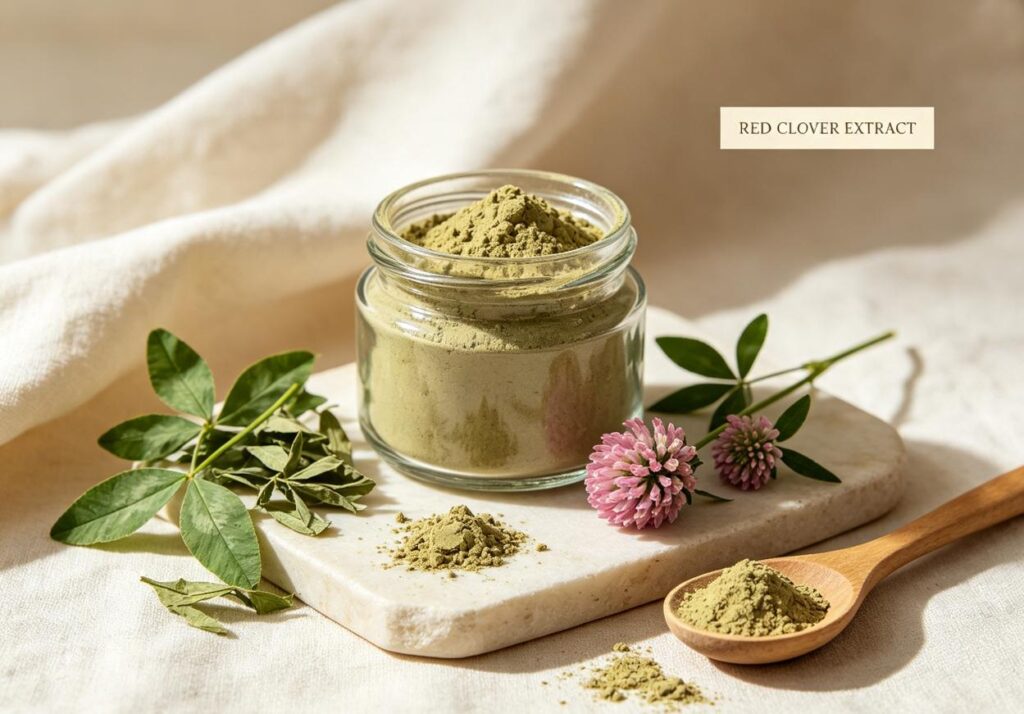
In commercial production, red clover extract is available in multiple standardized forms. Common specifications include total isoflavone content ranging from 8% to 40% (HPLC-verified), with powder extracts typically processed to 80–100 mesh particle size. The extract appears as a fine brown to dark green powder with a characterist ic odor .
Core Specifications & Quality Grades
For professional buyers, understanding specifications is the first step to accurate procurement. The core specifications of red clover extract are determined by isoflavone content, purity, and intended application.
Isoflavone Standardization – The Industry Benchmark
The key bioactive markers are the four principal isoflavones: biochanin A, formononetin, daidzein, and genistein. Premium extracts are standardized to 8%, 20%, or 40% total isoflavones by HPLC, with the 40% grade offering the highest potency per unit volume.
A systematic review and meta-analysis of eight randomized controlled trials demonstrated that supplementation with red clover isoflavones at 80 milligrams or more per day for at least 12 weeks led to a statistically significant reduction in daily hot flush frequency, with a weighted mean difference of -1.73 (95% CI -3.28 to -0.18). This quantified endpoint provides a reliable anchor for structure/function claims on menopausal comfort.
Application-Specific Grades
Lower-grade extracts at 2.5% to 8% total isoflavones are typically selected for functional foods, beverages, and daily nutrition products where the goal is to maintain a moderate isoflavone background in the finished product without dominating the taste profile. The 10% to 20% grade is the workhorse for conventional dietary supplements, capsules, and tablets, offering a balanced potency-to-cost ratio that supports clear label claims. High-potency formulations and women’s health-focused products generally require the 40% grade, where formulation precision and consistent active intake are critical.
Critical Quality Parameters
Total isoflavone content directly correlates with clinical dose flexibility and label claim accuracy, making it the most critical procurement parameter. Loss on drying must be controlled to 5.0% or less to prevent moisture-induced degradation and microbial growth during shelf life. Heavy metal limits must meet international supplement safety standards, with lead, arsenic, cadmium, and mercury strictly controlled. Particle size must ensure at least 95% through 80 mesh to guarantee flowability and blend uniformity in capsule and tableting lines.
Microbiological limits, including total plate count of 10,000 CFU per gram or less, yeasts and molds of 100 CFU per gram or less, and absence of E. coli, Salmonella, and Pseudomonas aeruginosa, ensure safety without over-processing that might degrade heat-sensitive isoflavones.
USP standards require that red clover tablets contain not less than 90.0 percent and not more than 110.0 percent of the labeled amount of isoflavones, with identification tests confirming the presence of all four isoflavone markers.
Core Benefits of Red Clover Extract
Red clover extract has been extensively studied for its wide-ranging biological effects, with findings deriving from in vitro, animal, and clinical evidence.
For menopausal comfort and hormonal balance, the isoflavones in red clover extract function as phytoestrogens with higher affinity for ERβ than ERα, potentially offering symptom relief with a more favorable side-effect profile compared to synthetic hormones. A standardized extract demonstrated estrogenic activity corresponding to approximately 18 micrograms of 17β-estradiol per gram of extract for ERα and approximately 78 micrograms per gram for ERβ.
For cardiovascular support, research suggests red clover isoflavones may help maintain healthy lipid profiles and vascular function. The antioxidant properties of the isoflavones contribute to their cardiovascular protective effects.
For bone and joint health, studies indicate that red clover isoflavones may support bone mineral density and joint health, making the extract relevant for formulations targeting bone and joint support.
For skin health and anti-aging, red clover extract’s antioxidant properties support its use in cosmetic and personal care applications, particularly in formulations aiming to improve skin elasticity and reduce signs of aging.
Applications & Industrial Value
Red clover extract is a versatile ingredient with applications spanning multiple industries.
In dietary supplements, red clover extract is most commonly used in women’s health, menopausal support, and cardiovascular wellness formulations. It is available in capsules, tablets, and powder sachets, with typical standardized dosages ranging from 80 to 200 milligrams per serving of isoflavone-standardized extract. It is often combined with other wellness-support ingredients such as black cohosh, soy isoflavones, or vitamin D for synergistic blends.
In functional foods and beverages, red clover extract is used in herbal teas, fortified beverages, and functional food products. Water-dispersible grades enable easy incorporation into dry premixes and instant drink mixes, with typical usage levels ranging from 0.5% to 2.0% of the formulation depending on the desired isoflavone content. The 8% grade disperses readily without sedimentation, while 20% and 40% grades are better suited for capsules or compressed tablets requiring higher potency per unit volume.
In cosmetics and personal care, red clover extract’s antioxidant and phytoestrogen properties support its use in anti-aging serums, moisturizers, and skincare formulations targeting skin elasticity and hormonal skin changes.
In cosmeceuticals, the extract serves as a natural active ingredient in formulations aiming to improve skin firmness and reduce visible signs of aging, aligning with clean beauty trends.
Supplier Selection & Quality Considerations
When sourcing red clover extract, verify that the product meets recognized standards. Botanical identity must be confirmed as Trifolium pratense, not a cheaper look-alike species. Isoflavone profile should be verified by HPLC for all four isoflavones—biochanin A, formononetin, daidzein, and genistein—not just total content. Standardization grade should be clearly stated as 8%, 20%, or 40% total isoflavones with batch-specific COA documentation. Manufacturing certifications including ISO 9001, GMP, HACCP, Halal, and Kosher should be available.
Heavy metal limits should meet international standards with lead below 3.0 milligrams per kilogram, arsenic below 1.0, cadmium below 1.0, and mercury below 0.1. Microbiological quality should show total plate count of 10,000 CFU per gram or less, yeasts and molds of 100 CFU per gram or less, and absence of Salmonella and E. coli. Pesticide residues should meet international standards for dietary supplements, and particle size should ensure at least 95% through 80 mesh for formulation compatibility.
Why Choose Our Red Clover Extract
As a professional botanical extract manufacturer, we offer high-quality, standardized red clover extract with multiple specification options including 8%, 20%, and 40% total isoflavone grades verified by HPLC. We provide full isoflavone profile verification of all four markers—biochanin A, formononetin, daidzein, and genistein—with water-dispersible grade available for beverage and functional food applications. Our products offer full traceability with complete COA documentation including heavy metals, microbiological, and pesticide testing, and flexible supply from 1 kilogram trial orders to full container shipments. We maintain GMP-certified production with ISO, Halal, and Kosher certifications available, and provide regulatory support with comprehensive documentation for US and EU market submissions.
Ready to try Red Clover Extract for your business? Contact us at info@xianherb.com for a free sample or wholesale price list.
Leave A Comment