
Global formulators and bulk buyers frequently ask what makes Ginger Extract a must-have ingredient for commercial production. The answer lies in its unique bioactive profile—particularly gingerols and shogaols—which have made it one of the most versatile botanical ingredients for functional foods, beverages, dietary supplements, and cosmetic formulations. With the global market valued at approximately USD 1.3 billion in 2024 and projected to reach USD 2.1 billion by 2033 at a CAGR of 5.5%, demand for high-quality, standardized ginger extract continues to grow across multiple industries .
What Is Ginger Extract?
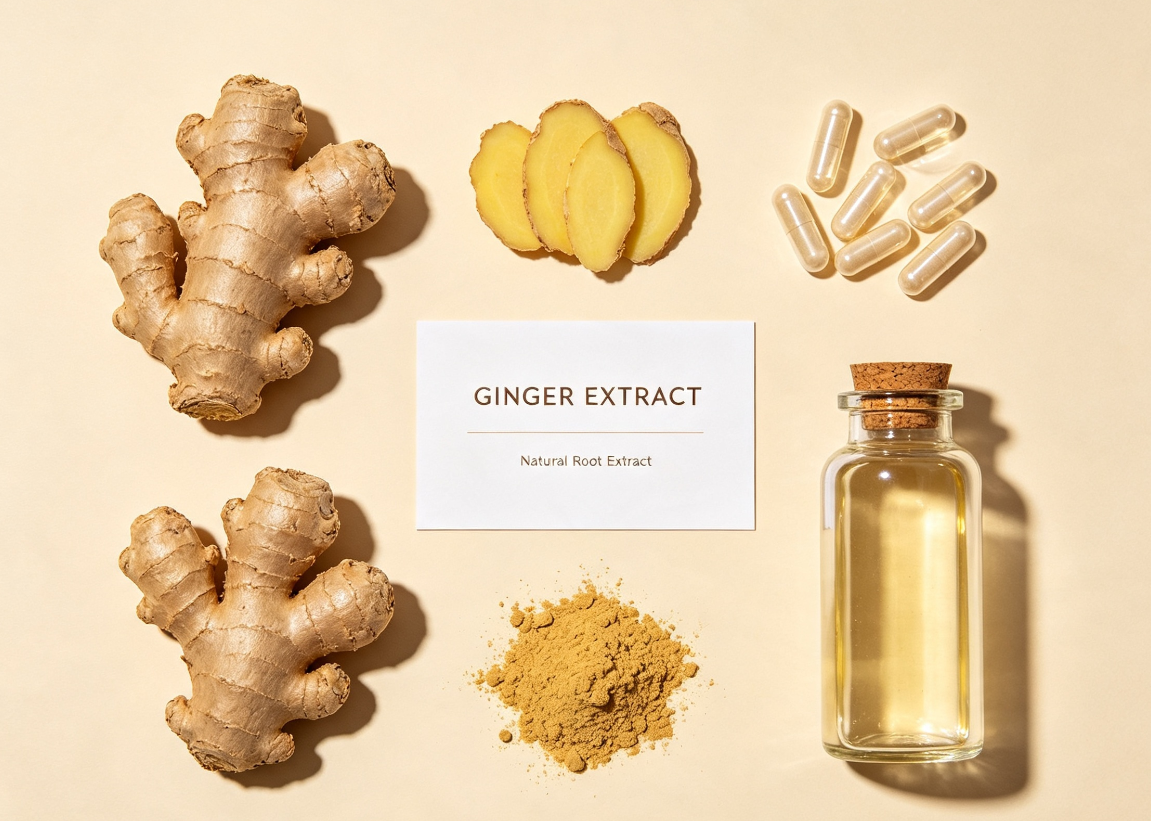
Ginger Extract is a concentrated botanical ingredient derived from the rhizome of Zingiber officinale, a flowering plant native to Southeast Asia that has been cultivated for thousands of years for both culinary and medicinal purposes. Through advanced extraction technologies—including water, ethanol, and supercritical CO₂ extraction—the active compounds are concentrated into a stable powder or liquid form.
The key bioactive marker is 6-gingerol, the primary pungent compound responsible for ginger’s characteristic warm, spicy flavour and its functional properties. Commercial grades are typically standardized to 5% total gingerols, with premium specifications available up to 20–40% for oleoresin versions . The extract appears as a light yellow to brownish-yellow powder with a characteristic spicy aroma and warm, pungent taste.
The Market Opportunity
The global ginger extract market is experiencing robust growth, driven by increasing consumer health awareness and a shift towards natural functional ingredients. Key demand indicators include the United States as the top import market, which imported 45.6 million kilograms valued at $1.14 billion in 2024, followed by South Korea with 93.4 million kilograms valued at $216.6 million, Germany with 6.0 million kilograms valued at $212.8 million, Italy with 26.2 million kilograms valued at $151.8 million, Spain with 8.6 million kilograms valued at $129.6 million, and the Netherlands with 30.5 million kilograms valued at $113.4 million. Major producing countries include India, Nigeria, China, Indonesia, and Thailand, which together supply the bulk of ginger rhizomes for global extract production.
Core Specifications
For professional buyers, the key specifications to verify are determined by gingerol content, purity, and intended application. Total gingerol content is typically offered at 5%, 10%, 20%, or 40% for oleoresin versions, verified by HPLC testing. The extract is available in powder form (light yellow to brownish-yellow) or liquid/oleoresin form (red-brown liquid). Particle size typically requires 95 to 100 percent passing through 80 mesh. Loss on drying should be below 5.0 percent, and heavy metals should meet food supplement standards with lead and arsenic levels strictly controlled. Microbiological quality must meet USP standards for total plate count, yeast and mold, and absence of Salmonella and E. coli.
A 2006 study published in Obstetrics & Gynecology revealed significant variation in gingerol content across 10 commercially available ginger supplements, with 6-gingerol concentrations ranging from 0.0 to 9.43 mg per gram. This underscores the critical importance of sourcing from suppliers who provide batch-specific HPLC-verified COA documentation to ensure consistent potency.
Applications & Industrial Value
Ginger Extract is a versatile ingredient with applications spanning multiple industries.
In dietary supplements and nutraceuticals, ginger extract is widely used in digestive health, immune support, and anti-inflammatory formulations. It is available in capsules, tablets, and powder sachets, with typical dosages ranging from 200 to 1,000 milligrams per serving depending on the gingerol specification. It is often combined with other functional ingredients such as turmeric, vitamin C, or probiotics for synergistic wellness blends.
In functional foods and beverages, ginger extract is used in teas, energy drinks, wellness shots, protein shakes, nutritional bars, and meal replacement products. Water-soluble powder grades enable easy formulation into ready-to-drink formats and dry blends. Typical usage levels range from 0.01% to 0.1% of the formulation for flavouring applications.
In bakery and confectionery, ginger extract is used in gingerbread, cookies, cakes, spiced candies, and flavoured syrups, providing authentic warm ginger flavour without the handling variability of fresh root.
In cosmetics and personal care, ginger extract’s antioxidant and skin-soothing properties support its use in skincare formulations targeting ageing and inflammation.
In savory food applications, ginger extract is widely used in meat processing, instant noodles, sauces, marinades, and restaurant cuisine for its characteristic fresh ginger aroma and flavor.
Extraction Methods & Grade Selection
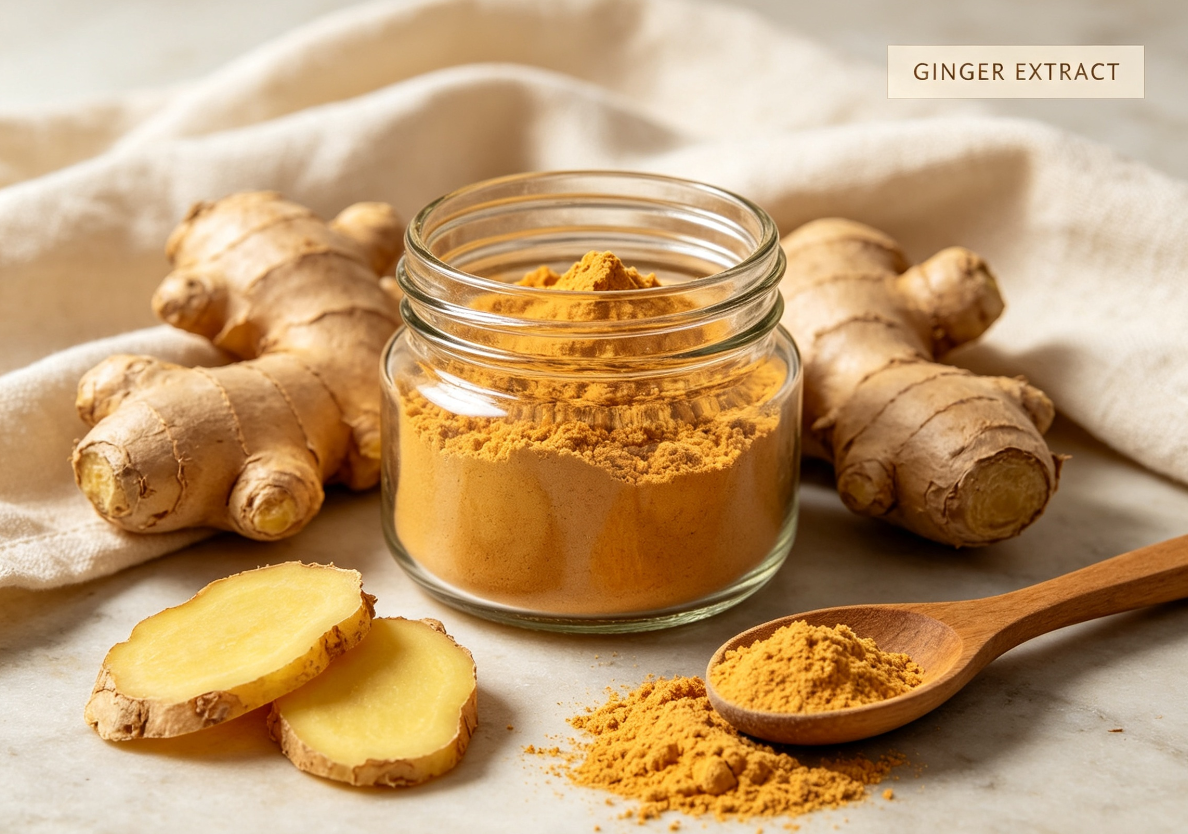
Different extraction methods yield different product profiles. Supercritical CO₂ extraction produces high-purity oleoresin with concentrated gingerol content at 20 to 40 percent, preserving the full spectrum of volatile compounds. This method is ideal for premium applications. Solvent extraction using water or ethanol is the most common method for powder extracts, producing standardized gingerol content typically at 5 to 10 percent, suitable for most supplement and food applications.
For application-specific grades, powder extract at 5 percent gingerols is best for capsules, tablets, and dry blends. Oleoresin at 20 to 40 percent gingerols is ideal for liquid formulations, flavour systems, and meat processing. Essential oil with volatile oil content of 99 percent or higher is used in flavour and fragrance applications. The 100:1 extract at 0.1 to 0.3 percent gingerols provides high-concentration powder for beverages and functional foods.
Regulatory & Quality Standards
When sourcing ginger extract, it is essential to verify that the product meets recognized standards. In the United States, ginger extract has GRAS (Generally Recognized as Safe) status for use in foods and beverages. For dietary supplements, manufacturing must comply with FDA GMP requirements under 21 CFR Part 111. In the EU, for food supplements, ginger extract may fall under the Novel Food Regulation if a specific preparation is new to the EU market. For cosmetics, the ingredient should be listed in the CosIng database.
A comprehensive supplier audit should verify analytical potency through HPLC verification of gingerol content and identity tests such as TLC or HPLC fingerprinting to rule out adulteration. Safety contaminants including heavy metals (lead, cadmium, arsenic, mercury), pesticide residues meeting EU MRLs, and microbiological purity must be documented. Raw material integrity requires origin of ginger rhizomes, extraction method documentation, and supply chain traceability. Industry certifications including GMP, HACCP, ISO, Halal, and Kosher are available from qualified suppliers.
Why Choose Our Ginger Extract
As a professional ginger extract manufacturer, we offer high-quality, standardized extracts with multiple specification options including 5%, 10%, 20%, and 40% gingerol grades. We provide multiple forms including powder extract, oleoresin, and essential oil, produced through advanced extraction technologies including supercritical CO₂ and solvent extraction. Our products offer full traceability with complete COA documentation including HPLC verification, heavy metals, and microbiological testing. We provide flexible supply from 1-kilogram trial orders to full container shipments, with GMP-certified production and ISO, Halal, Kosher, and organic certifications available. We also provide regulatory support including GRAS dossier, COA, and compliance documentation for US and EU markets.
Ready to try Ginger Extract for your business? Contact us at info@xianherb.com for a free sample or wholesale price list.
Leave A Comment