
Global formulators and bulk buyers frequently ask what makes St. John‘s Wort Extract a must-have ingredient for commercial production. The answer lies in its unique phytochemical profile—particularly hypericin and hyperforin—which has made it one of the most researched botanical ingredients for mood support, stress management, and sleep wellness formulations. With the global market continuing to expand across nutraceutical, pharmaceutical, and functional food applications, demand for high-quality, standardized St. John‘s Wort extract is growing steadily.
What Is St. John’s Wort Extract?
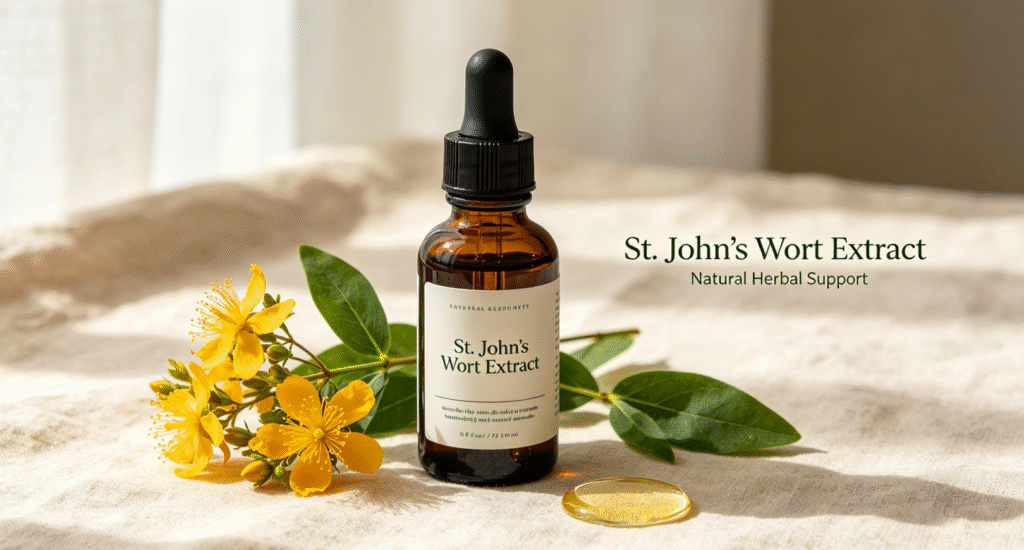
St. John‘s Wort Extract is a concentrated botanical ingredient derived from the flowering tops of Hypericum perforatum L., a plant native to Europe, Asia, and North Africa that has been used in traditional medicine for over 2,000 years. The extract is valued for its naturally occurring bioactive compounds, particularly hypericin and hyperforin, which serve as the primary quality markers for standardization and formulation consistency.
The extract appears as a dark brown to reddish-brown fine powder with a characteristic odor. In commercial production, St. John‘s Wort extract is available in multiple standardized forms. Common specifications include hypericin content ranging from 0.3% to 3.0% (HPLC-verified) and hyperforin content from 1.0% to 5.0% . The extract is typically processed at ratios of 4:1 to 10:1, depending on the specific formulation requirements.
Core Specifications & Quality Grades
For professional buyers, understanding specifications is the first step to accurate procurement. The core specifications of St. John’s Wort extract are determined by active marker content, purity, intended application, and extraction method.
Hypericin Standardization – The Industry Benchmark
The key bioactive markers are hypericin, a naphthodianthrone compound, and hyperforin, a phloroglucinol derivative. The standard commercial specification for St. John‘s Wort extract is 0.3% hypericin (HPLC-verified), with higher-purity grades available up to 3.0% for premium formulations. For applications requiring broader marker control, extracts are also standardized to total hypericins (hypericin and pseudohypericin) or hyperforin content.
Common Commercial Specifications
Standard commercial specifications typically include hypericin content at 0.3% (HPLC-verified) and extract ratios ranging from 4:1 to 10:1. Appearance is described as dark brown to reddish-brown fine powder. Loss on drying should be 5.0% or less, and ash content should be 5.0% or less. Heavy metal limits must meet international supplement standards, and microbiological quality must meet USP requirements for total plate count, yeast and mold, and absence of Salmonella and E. coli.
Application-Specific Grades
Not all St. John‘s Wort extracts are the same. Depending on your application, you may need different grades. The 0.3% hypericin grade is the standard specification for dietary supplements and capsules, offering a balanced potency-to-cost ratio. The 1.0% to 3.0% hypericin grade is preferred for high-potency formulations and pharmaceutical applications requiring precise marker control. Ratio extracts at 4:1 to 10:1 provide a full-spectrum profile, suitable for traditional capsules and powder blends. Water-soluble grades are available for beverage and liquid formulations, with enhanced solubility for functional drinks and drops.
Critical Quality Parameters
The most critical procurement parameter is hypericin content with clear HPLC method disclosure. A COA that only states “Hypericin 0.3%” without specifying the analytical method and reference standard should be treated as incomplete for procurement-grade approval. The assay basis must be clearly stated to ensure comparability across batches and suppliers.
Loss on drying should be controlled to 5.0% or less to prevent moisture-induced degradation and microbial growth during shelf life. Heavy metal limits must meet international supplement safety standards with lead, arsenic, cadmium, and mercury strictly controlled. Particle size should ensure at least 95% through 80 mesh to guarantee flowability and blend uniformity in capsule and tableting lines. Microbiological limits ensure safety without over-processing that might degrade heat-sensitive compounds.
Fingerprinting protects you from “same number, different profile.” A buyer-friendly fingerprint package for St. John‘s Wort Extract should include a reference chromatogram (golden batch) and a current-lot chromatogram, retention time windows for major peaks, acceptance criteria (similarity index or peak ratio bands), and system suitability rules to keep fingerprints comparable.
Clinical Evidence & Core Benefits
St. John’s Wort extract has been extensively studied for its wide-ranging biological effects, with findings derived from in vitro, animal, and clinical evidence.
For mood support and emotional wellness, St. John‘s Wort is one of the most thoroughly researched botanical ingredients for mood support. Clinical studies have demonstrated its efficacy in supporting healthy mood balance and emotional wellness. The proposed mechanism involves modulation of neurotransmitter activity, including serotonin, dopamine, and noradrenaline pathways. A 2023 systematic review of 27 studies concluded that hypericum extract was effective for mild to moderate mood support, with a comparable efficacy profile to conventional alternatives.
For stress management and nervous system support, research suggests that St. John’s Wort may help support healthy stress responses and nervous system function. The hyperforin content is believed to contribute to these effects through its interaction with the GABAergic system.
For sleep quality and relaxation, St. John‘s Wort has been traditionally used to support healthy sleep patterns. Research indicates that the extract may help support restful sleep through its effects on melatonin regulation and nervous system calming.
For menopausal comfort, research suggests that St. John’s Wort may help support women‘s health during menopause transitions, potentially contributing to improved quality of life and emotional balance.
For anti-inflammatory support, studies have documented the anti-inflammatory properties of St. John’s Wort extract, with research suggesting potential applications in formulations targeting inflammatory conditions.
Applications & Industrial Value
St. John‘s Wort extract is a versatile ingredient with applications spanning multiple industries.
In dietary supplements and nutraceuticals, St. John’s Wort extract is most commonly used in mood support, stress management, and sleep wellness formulations. It is available in capsules, tablets, and powder sachets, with typical standardized dosages ranging from 100 to 300 milligrams per serving of 0.3% hypericin-standardized extract. It is often combined with other wellness-support ingredients such as valerian root, passionflower, or lemon balm for synergistic blends.
In functional foods and beverages, St. John‘s Wort extract is emerging as a fortifying ingredient for relaxation teas, wellness shots, and stress-support products. Water-soluble grades enable easy incorporation into dry premixes and instant drink mixes, with typical usage levels ranging from 0.5% to 2.0% of the formulation depending on the desired hypericin content.
In cosmetics and personal care, St. John’s Wort extract‘s antioxidant and anti-inflammatory properties support its use in skincare formulations targeting skin vitality and protection from environmental stress.
Safety & Regulatory Status
St. John’s Wort extract is widely recognized as a dietary supplement ingredient in North America, Europe, and Asia. However, it has important drug interaction considerations that downstream manufacturers must address.
Drug Interactions: St. John‘s Wort is known to induce cytochrome P450 enzymes (CYP3A4, CYP2C9, CYP1A2) and P-glycoprotein, which can reduce the efficacy of numerous pharmaceutical drugs. Formulations should include appropriate warnings for consumers taking prescription medications.
Safety Considerations: St. John’s Wort may cause photosensitivity in some individuals. Products should include warnings about potential skin sensitivity to sunlight. It should not be used during pregnancy or breastfeeding without medical supervision.
Regulatory Status: In the United States, St. John‘s Wort is regulated as a dietary supplement. In the European Union, it is available as both a food supplement and a registered herbal medicine (traditional use registration). In Canada, it is regulated under the Natural Health Products Regulations.
Quality Documentation: A responsible supplier should provide batch-specific COA documents confirming hypericin content, heavy metals, pesticide residues, and microbiological safety. For pharmaceutical applications, additional documentation such as stability data and extraction method validation may be required.
Supplier Selection & Quality Considerations
When sourcing St. John’s Wort extract, verify that the product meets recognized standards. Botanical identity must be confirmed as Hypericum perforatum L., not a cheaper look-alike species such as Hypericum maculatum or other Hypericum species. Hypericin profile should be verified by HPLC, not just total content. Standardization grade should be clearly stated with batch-specific COA documentation. Manufacturing certifications including GMP, ISO, HACCP, Halal, and Kosher should be available.
Heavy metal limits should meet international standards. Microbiological quality should show absence of pathogens. Pesticide residues should meet international standards for dietary supplements, and particle size should ensure formulation compatibility.
Species Confirmation: St. John‘s Wort is a hypericum species with varying active compound profiles. Reputable suppliers should provide species confirmation through HPLC fingerprinting and botanical identification.
Harvest Time Impact: The concentration of hypericin and hyperforin in St. John’s Wort varies significantly depending on the harvest time, with the highest concentrations typically found during the flowering period. Suppliers should provide harvest date information to support quality assessment.
A reliable St. John‘s Wort extract manufacturer should offer controlled raw material sourcing, food-grade or pharmaceutical-grade extraction, HPLC-based hypericin analysis, batch-to-batch consistency, and full traceability documentation.
Why Choose Our St. John’s Wort Extract
As a professional botanical extract manufacturer, we offer high-quality, standardized St. John‘s Wort extract with multiple specification options including 0.3% hypericin grade (HPLC), 1.0% to 3.0% high-potency grades, and ratio extracts from 4:1 to 10:1. We provide water-soluble grades for beverage applications with full traceability and complete COA documentation including heavy metals, microbiological, and pesticide testing. Our flexible supply ranges from trial orders to full container shipments, and we maintain GMP-certified production with ISO, Halal, and Kosher certifications available.
Ready to try St. John’s Wort Extract your business? Contact us at info@xianherb.com for a free sample or wholesale price list.
Leave A Comment