
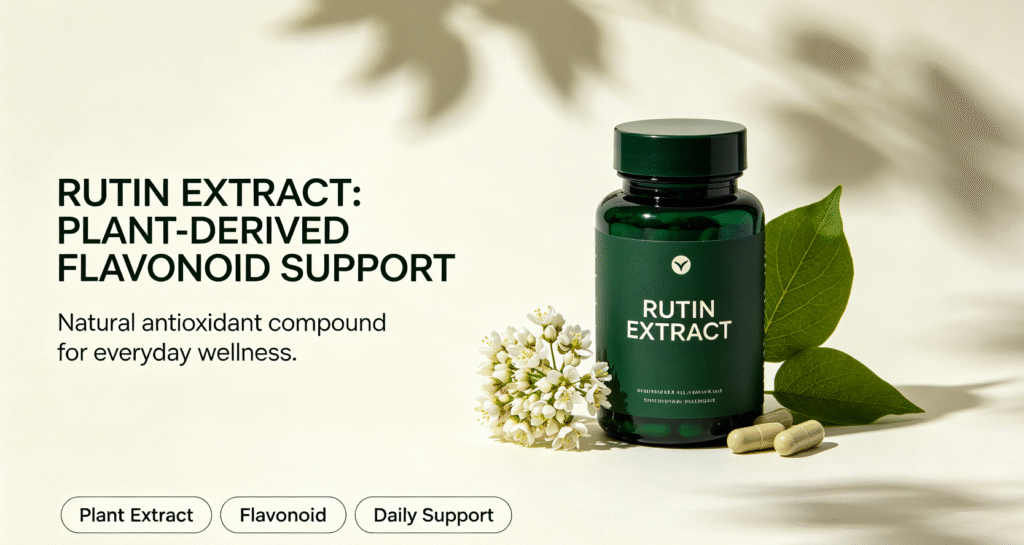
For centuries, European herbalists sought a natural compound capable of strengthening blood vessels and preventing hemorrhage. Their search led them to the leaves and flowers of buckwheat—a seemingly ordinary crop harboring an extraordinary flavonoid. Modern science named this compound Rutin, also known as Vitamin P. From maintaining capillary integrity to defending against oxidative stress, rutin is emerging as one of the most scientifically grounded natural ingredients in functional foods, dietary supplements, and pharmaceutical formulations.
What Is Rutin?
Rutin, chemically known as quercetin-3-O-rutinoside, is a flavonol glycoside widely distributed throughout the plant kingdom. It occurs naturally in buckwheat, black tea, apples, citrus fruits, asparagus, and numerous medicinal plants, with buckwheat recognized as one of the best dietary sources of rutin.
Structurally, rutin consists of quercetin—a potent antioxidant flavonoid—linked to rutinose, a disaccharide composed of rhamnose and glucose. This unique glycosidic structure gives rutin properties distinct from ordinary quercetin, particularly its distinctive activity in vascular protection.
Industrially, rutin is obtained primarily through plant extraction (such as from buckwheat or Sophora japonica flower buds) or semi-synthesis. Quality-standard rutin is typically supplied as a yellow-green to yellow-brown powder, with standardized specifications indicating rutin content (e.g., 95%, 98%).
The Mechanism of Rutin: More Than Just an Antioxidant
Capillary Protection—Rutin’s “Classic Function”
Rutin first attracted scientific attention precisely because of its unique effects on vascular health. Research dating back to the 1940s confirmed that rutin can effectively improve hypertension-related capillary fragility, restoring it to normal levels and thereby preventing retinal hemorrhage and cerebrovascular accidents.
The mechanism behind this effect lies in rutin‘s ability to reduce capillary permeability and fragility while enhancing the resistance of blood vessel walls. It is this function that earned rutin the common name “Vitamin P”—with “P” standing for Permeability. For microvascular fragility caused by hypertension, diabetes, or aging, rutin offers a natural, gentle intervention option.
Antioxidant and Anti-Inflammatory: Comprehensive Cellular Protection
As a standout member of the flavonoid family, rutin demonstrates powerful free radical scavenging capacity. Studies show that rutin effectively neutralizes superoxide anion radicals, peroxyl radicals, and various other oxidative species.
More critically, rutin’s anti-inflammatory mechanism involves the inhibition of the NLRP3 inflammasome pathway. The NLRP3 inflammasome plays a central role in oxidative stress-induced chronic inflammation, and rutin can suppress its overactivation by scavenging reactive oxygen species (ROS). This discovery provides a molecular-level explanation for rutin‘s applications in inflammatory bowel disease, metabolic inflammation, and related fields.
Metabolic Regulation: From Blood Sugar to Blood Lipids
Recent research has unveiled rutin’s potential in metabolic regulation. Rutin can activate the AMPK signaling pathway and IRS2 signaling pathway, helping maintain the functional integrity of pancreatic β-cells and improving insulin resistance. In streptozotocin-induced diabetic rat models, rutin-rich extracts demonstrated clear hypoglycemic effects.
In lipid metabolism, rutin also exhibits regulatory activity. Studies report that rutin can inhibit glycation modification of low-density lipoprotein (LDL) and modulate enzyme activities related to lipoprotein metabolism. These findings position rutin as a noteworthy ingredient in metabolic syndrome management formulations.
Health Benefits Supported by Scientific Evidence
Vascular Health and Circulatory Support
Rutin‘s most classic application area is vascular protection. Early clinical studies confirmed that rutin effectively improves capillary fragility in hypertensive patients, preventing hemorrhagic complications. In the management of chronic venous insufficiency, rutin and its derivatives are widely used to relieve symptoms such as leg heaviness, swelling, and pain.
Potential Adjunct for Inflammatory Bowel Disease
A registered clinical trial has evaluated rutin‘s effects in ulcerative colitis (UC). The study employed a regimen of rutin 500 mg twice daily for 30 days, with the primary endpoint being the proportion of patients achieving a Simple Clinical Colitis Activity Index (SCCAI) score ≤5. The study design was based on rutin’s molecular mechanism of NLRP3 inflammasome inhibition, providing clinical-level exploration of natural flavonoids in intestinal inflammation management.
Combination Approach for Metabolic-Associated Fatty Liver Disease
Another clinical trial expected to launch in 2026 will evaluate rutin combined with vitamin C in patients with metabolic-associated fatty liver disease (MASLD). The protocol involves a combination tablet containing 60 mg rutin + 160 mg vitamin C, taken three times daily for 12 weeks, with primary observations focused on changes in inflammatory marker TNF-α and oxidative stress marker MDA. This research reflects the growing attention to rutin in the field of liver protection.
Antioxidant and Neuroprotective Effects
Rutin‘s antioxidant capacity extends beyond peripheral tissues. Studies demonstrate that in diabetic rat models, rutin can provide retinal neuroprotection through anti-apoptotic mechanisms, Bcl-2 upregulation, and caspase-3 downregulation. While these findings require further clinical validation, rutin’s potential in neuroprotective formulations warrants continued attention.
Safety and Dosage Considerations
Safety Assessment by Authoritative Bodies
The Norwegian Scientific Committee for Food Safety (VKM) published a systematic risk assessment of rutin and quercetin in 2024. Based on a review of 23 randomized controlled trials, VKM concluded that rutin at a daily dose of 25 mg in dietary supplements is safe for adults for at least three months.
In the report, researchers observed very few adverse reactions, all of low severity. Some studies even used higher doses (e.g., 1500 mg, 3000 mg, 4000 mg) with good tolerability. One study reported no toxicity or adverse effects even at extremely high doses exceeding 500 mg/kg/day.
The Challenge of Absorption and Bioavailability
Despite its reassuring safety profile, rutin‘s primary technical challenge lies in its poor water solubility and low oral bioavailability. Orally administered rutin is slowly absorbed in the small intestine and undergoes hydrolysis by gut microbiota.
While this characteristic limits rutin’s systemic exposure, it does not mean rutin is ineffective—on the contrary, high local concentrations of rutin in the gut may be the basis for its intestinal anti-inflammatory effects. For formulations requiring systemic action, researchers have developed multiple solutions, including liposomes, polymeric micelles, nanoparticles, and phospholipid complexes (such as rutin nanophytosomes) as delivery systems.
Formulation Recommendations
In practical product development, rutin can be adapted to multiple dosage forms. Powder form is popular in the dietary supplement sector for its flexibility and ease of use, while tablets hold a significant market share due to their convenience and long shelf life.
For applications requiring enhanced bioavailability, rutin-sodium caseinate colloidal systems have been shown to significantly improve rutin‘s solubility and chemical stability, forming nanoparticles in the 185–230 nm range with encapsulation efficiency of 76–83%. This technological pathway opens new possibilities for rutin’s application in functional foods and beverages.
Market Outlook: A Steadily Growing Natural Ingredient
The global rutin extract market is on a steady growth trajectory. According to market research data, the global rutin extract market was valued at approximately USD 351.3 million in 2025 and is projected to reach USD 828.4 million by 2034, representing a compound annual growth rate of 10.0%.
This growth is driven by multiple factors: rising consumer awareness of natural antioxidants, continued expansion of the dietary supplement market, and increasing pharmaceutical industry interest in naturally sourced functional ingredients. Rutin has applications across dietary supplements, pharmaceuticals, food and beverages, and cosmetics, providing broad market coverage.
In terms of product forms, both natural and synthetic rutin coexist, but naturally sourced rutin is more favored under the clean-label trend. Major market participants are concentrated in China, India, Europe, and North America, with China serving as an important rutin raw material supply base.
Why Choose Xi‘an Herb Bio
As a professional supplier of natural plant ingredients, Xi’an Herb Bio-Tech Co., Ltd provides high-quality rutin extract to global customers:
-
Multiple standardized specifications: Rutin extracts available in various purity grades to meet needs ranging from dietary supplements to pharmaceutical excipients
-
Complete quality documentation: Every order includes COA (Certificate of Analysis), specification sheets, and ingredient composition for full traceability
-
Flexible purchasing options: MOQ starting from just 1 kg for initial evaluation and small-batch trial production
-
Customization services: Private-label and custom specification support to help customers build their own brands
-
Quality certifications: ISO, Halal, Non-GMO, and other certification options available
Whether you are developing vascular health supplements, antioxidant formulas, metabolic support products, or functional foods, rutin is a natural ingredient with a solid scientific foundation and market demand.
Ready to try Rutin for your business? Contact us at info@xianherb.com for a free sample or wholesale price list.
Leave A Comment