
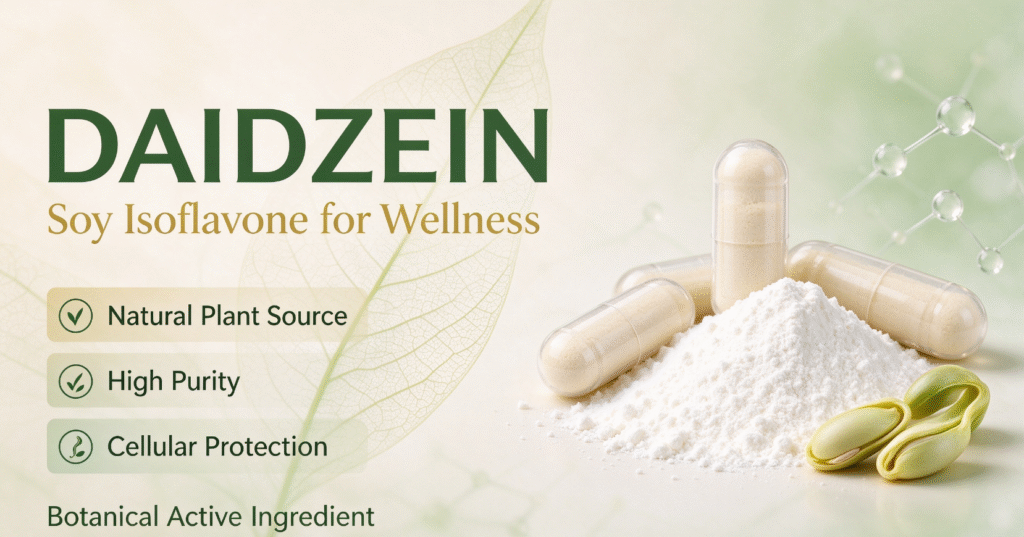
In the evolving landscape of plant-based nutraceuticals, few compounds bridge traditional dietary wisdom and modern therapeutic science as seamlessly as daidzein. As one of the principal soy isoflavones alongside genistein, this naturally occurring phytoestrogen has moved from a subject of academic curiosity to a commercially significant ingredient in the global health and nutrition market. For formulators, supplement brands, and B2B buyers seeking evidence-backed natural solutions for women’s health, cardiovascular support, and healthy aging, daidzein offers a rare combination: a well-characterized mechanism of action, a growing body of clinical research, and a supply chain increasingly anchored in Asia-Pacific production capabilities.
What Is Daidzein?
Daidzein (7,4‘-dihydroxyisoflavone) is a natural isoflavone classified under the broader family of phytoestrogens. It is found primarily in soybeans and other legumes, including kudzu root and red clover. The compound exists in plants predominantly as glycosides—daidzin being the most common form—which are converted to the bioactive aglycone daidzein through enzymatic hydrolysis during extraction or digestion.
From a chemical perspective, daidzein is a white to off-white crystalline powder with a molecular formula of C₁₅H₁₀O₄ and a molecular weight of approximately 254.24 g/mol. It is practically insoluble in water but soluble in ethanol and ether, a characteristic that has significant implications for formulation and bioavailability.
The pharmacological activity of daidzein is attributed to its structural similarity to endogenous estradiol, enabling it to bind estrogen receptors and exert selective estrogen receptor modulator (SERM)-like effects. Importantly, daidzein can be further metabolized by gut microbiota into equol, a metabolite with higher estrogenic potency and potentially greater clinical relevance. This metabolic pathway is a critical consideration for both product positioning and clinical efficacy expectations, as only approximately 30–50% of Western populations are “equol producers”.
Commercial daidzein products are typically offered as high-purity extracts (≥98% by HPLC) or as standardized soy isoflavone blends containing defined ratios of daidzein, genistein, and glycitein. The compound is also available in glycoside form (daidzin) for applications requiring enhanced water solubility.
Mechanism of Action: A Multi-Target Phytoestrogen
Unlike synthetic hormone replacement therapies that exert systemic estrogenic effects, daidzein works through mechanisms that offer a more nuanced and targeted approach. This distinction is critical for formulators developing products for menopausal support, bone health, and cardiovascular wellness.
Selective estrogen receptor modulation. Daidzein binds with higher affinity to estrogen receptor beta (ERβ) than to ERα, a selectivity profile that underlies many of its tissue-specific effects. ERβ is predominantly expressed in bone, cardiovascular tissues, and certain brain regions, while ERα is more prominent in breast and uterine tissue. This differential binding may contribute to daidzein‘s potential bone-protective and cardiovascular benefits with a more favorable safety profile compared to conventional hormone therapy.
Antioxidant and anti-inflammatory pathways. Daidzein and its metabolites demonstrate significant antioxidant activity, including scavenging of free radicals and upregulation of endogenous antioxidant enzymes. These properties help mitigate oxidative stress, a key driver of age-related cellular damage and chronic disease progression.
Bone metabolism modulation. Preclinical and clinical evidence indicates that daidzein can suppress osteoclast activity (bone resorption) while potentially supporting osteoblast function (bone formation). This mechanism aligns with classical estrogen-mediated bone protection, offering a natural alternative for postmenopausal women at risk of osteoporosis.
Cardiovascular protection. Daidzein has demonstrated the ability to improve lipid profiles, enhance endothelial function, and reduce vascular inflammation. In animal models, daidzein showed anti-arrhythmic effects and improved blood flow to coronary and cerebral arteries.
Bioavailability considerations. Native daidzein has limited oral bioavailability (approximately 6% in animal models) due to poor water solubility and extensive first-pass metabolism. This challenge has driven significant innovation in formulation technologies, including nanoparticle delivery systems, liposomal encapsulation, and emulsion-based approaches designed to enhance solubility, stability, and target tissue delivery.
Clinical Evidence: What the Research Shows
For B2B buyers evaluating daidzein for product development, understanding the clinical evidence base is essential for accurate positioning and compliant claim substantiation.
Menopausal symptom management. Clinical trials assessing daidzein and genistein for vasomotor symptoms have produced mixed but generally encouraging results. Genistein-enriched preparations have demonstrated more consistent efficacy, with daily supplementation of 30–54 mg significantly reducing hot flash frequency and severity in some trials—effects that appear more pronounced in equol-producing women. Daidzein‘s efficacy in this indication is closely tied to individual metabolic capacity, highlighting the importance of personalized approaches.
Bone health. The bone-protective properties of soy isoflavones are more consistently supported by clinical evidence than menopausal symptom relief. A double-blind, placebo-controlled RCT involving 100 postmenopausal women found that a soy extract nutraceutical significantly improved bone turnover markers compared to placebo over 12 weeks. Systematic reviews and meta-analyses report that both genistein and daidzein can reduce bone resorption and help maintain bone mineral density, with the most pronounced effects observed in interventions lasting at least 12 months.
Cardiovascular health. Daidzein has been evaluated for its effects on lipid profiles and cardiovascular risk markers. A single-dose safety study in postmenopausal women found a 7% decrease in systolic and diastolic blood pressure 24 hours after administration of purified isoflavone preparations. These findings suggest potential cardiovascular benefits that warrant further investigation in larger, longer-term trials.
Safety and tolerability. Clinical and epidemiological data are generally reassuring regarding daidzein safety at dietary and supplemental levels. A single-dose pharmacokinetic study in postmenopausal women found minimal clinical toxicity when isoflavones were administered at amounts exceeding normal dietary intake. Human safety evaluations of standardized soy isoflavone extracts have not identified significant adverse effects at recommended doses. The most commonly reported side effects include mild gastrointestinal discomfort, nausea, and dry mouth.
Regulatory Landscape: Key Considerations for B2B Buyers
Daidzein is regulated as a component of soy isoflavone preparations in most major markets, with specific requirements varying by jurisdiction.
China. The National Medical Products Administration (formerly SFDA) has issued specific regulations for health foods containing soy isoflavones. Key requirements include: soy isoflavone raw materials must be sourced from soybeans; products must declare the content of daidzin, daidzein, genistin, and genistein individually as well as total isoflavone content; the recommended daily intake should not exceed 60 mg; and the target population is adult women, with children, pregnant/nursing women, and individuals with gynecological tumors or family history excluded.
United States. Soy isoflavones, including daidzein, are regulated as dietary supplement ingredients. Structure/function claims related to menopausal support and bone health are permissible with appropriate substantiation, while disease claims require FDA approval.
Europe. Soy isoflavones are used in traditional herbal medicinal products and food supplements in several EU member states. Claims must comply with the EU Health Claims Regulation, and products containing isoflavones intended for postmenopausal women typically carry specific labeling requirements.
Market Landscape: A Growing Global Opportunity
The global daidzein market was valued at approximately USD 282.4 million in 2025 and is projected to reach USD 531.07 million by 2031, expanding at a CAGR of 11.1%. This growth trajectory reflects the broader consumer shift toward plant-based health solutions and preventive wellness approaches.
Regional dynamics. Asia-Pacific dominates the daidzein market with approximately 43% share, supported by large-scale soybean cultivation and ingredient manufacturing capabilities in China, alongside strong cultural familiarity with isoflavone consumption in Japan and South Korea. North America accounts for approximately 26% of the market, led by the United States, where dietary supplement adoption and preventive healthcare awareness continue to drive demand. Europe holds nearly 21% share, with Germany, France, Italy, and the UK as major demand centers.
Application segments. Nutraceuticals and dietary supplements represent the largest application segment, contributing approximately 48% of global market revenue. The human health and nutrition industry leads overall consumption with nearly 58% market share, driven by the global expansion of supplement adoption. Animal feed represents a significant secondary application, particularly for poultry and livestock production enhancement.
Product form trends. Powdered daidzein accounts for nearly 55% of global demand, driven by its superior stability, extended shelf life, and versatility across multiple formulation formats including capsules, tablets, and functional foods. Direct B2B sales dominate distribution channels with approximately 52% market share, reflecting long-term supply agreements between ingredient manufacturers and finished-product brands.
Consumer trends. The growing interest in natural menopause support, “clean label” hormone alternatives, and preventive bone health continues to drive demand for soy isoflavone ingredients. Daidzein‘s established presence in traditional Asian diets and its GRAS-adjacent regulatory status in key markets make it particularly attractive for brands targeting women’s health and healthy aging demographics.
Application Scenarios and Formulation Strategies
Menopausal health supplements. The largest application category for daidzein, typically formulated into capsules or tablets for daily supplementation. Key formulation considerations include achieving clinically relevant doses (often 40–60 mg total isoflavones per day) while managing serving size, and communicating equol-producer status in marketing to set appropriate efficacy expectations.
Bone health products. Given the clinical evidence in postmenopausal women, daidzein is a strong candidate for products targeting age-related bone loss. Formulators may combine it with calcium, vitamin D3, and vitamin K2 for comprehensive bone support formulations.
Cardiovascular wellness blends. Daidzein‘s effects on lipid profiles and blood pressure make it suitable for cardiovascular support products. It is frequently combined with omega-3 fatty acids, CoQ10, and plant sterols in heart-health formulations.
Functional foods and beverages. Daidzein can be incorporated into functional foods, particularly those targeting menopausal women. However, its poor water solubility presents formulation challenges; advanced delivery systems such as nanoemulsions and liposomal encapsulation are increasingly employed to overcome these limitations.
Animal nutrition. Daidzein has demonstrated efficacy in poultry and livestock production, promoting growth performance and immune function. This represents a significant and growing application segment, particularly in Asia-Pacific markets.
Product Specifications and Quality Control
As a B2B ingredient, the value of daidzein lies in purity standardization, batch-to-batch consistency, and contaminant control.
Typical specifications. High-purity daidzein is available at ≥98% (HPLC). Standardized soy isoflavone extracts typically contain 40% total isoflavones, with daidzein representing 15–25% of the isoflavone fraction. The product is typically a white to off-white fine powder, soluble in ethanol and dimethyl sulfoxide, and practically insoluble in water.
Quality control considerations. Inconsistent isoflavone profiles between batches is a common challenge in soy-derived ingredient sourcing. Best practices include rigorous HPLC-based quantification of individual isoflavones (daidzin, daidzein, genistin, genistein, glycitin, glycitein), not just total isoflavone content. Third-party testing for heavy metals (lead, arsenic, mercury, cadmium), microbials, and residual solvents is essential. Non-GMO and allergen statements are increasingly required by brand customers.
Documentation support. Complete documentation includes Certificate of Analysis (COA), Material Safety Data Sheet (MSDS), specification sheet, and third-party test reports. For products targeting regulated markets, additional documentation may include GMP certificates, ISO certifications, and non-GMO project verification.
Safety and Regulatory Considerations
Daidzein has a favorable safety profile at commonly consumed doses, but important caveats apply.
Toxicity data. Preclinical toxicology studies indicate no significant genotoxicity for daidzein at dietary levels. A 28-day rat study found that high-dose daidzein administration (1000 mg/kg/day, reduced to 300 mg/kg/day after 14 days due to reduced food consumption and body weight loss) produced dose-dependent metabolic perturbations, but no frank toxicity at lower doses.
Precautions and drug interactions. Daidzein may interact with medications metabolized by the cytochrome P450 system. Individuals taking thyroid medications, anticoagulants (e.g., warfarin), or hormone-sensitive medications should consult a healthcare provider. Caution is advised for individuals with a history of hormone-dependent cancers, and products containing daidzein should be avoided by pregnant and nursing women, children, and individuals with gynecological tumors.
Regulatory implications for B2B buyers. Brands should ensure that product claims are consistent with local regulations and supported by appropriate evidence. In China, specific labeling requirements apply, including the mandatory statement: “不宜与含大豆异黄酮成分的产品同时食用,长期食用注意妇科检查”.
Why Choose Xi‘an Herb Bio-Tech Daidzein?
As a professional botanical extract supplier, Xi’an Herb Bio-Tech Co., Ltd offers daidzein and soy isoflavone products that meet the rigorous requirements of B2B buyers:
Multiple grades for diverse applications. From high-purity daidzein (≥98%) for pharmaceutical and clinical-use applications to standardized soy isoflavone extracts (40% total isoflavones) for cost-sensitive supplement formulations, we provide specification options to match your formulation and budget requirements.
Complete documentation support. Every shipment includes COA, MSDS, specification sheet, and third-party test reports covering heavy metals, microbials, and residual solvents. Our quality control processes are aligned with standard pharmacopoeial methods for isoflavone quantification.
Flexible supply. Minimum order quantities as low as 1 kg for trial orders, with scalable pricing for commercial volumes. We support custom packaging and labeling to meet your brand requirements.
Stable supply chain. Leveraging our established network of soybean cultivation partners and our own production capabilities, we ensure consistent availability and batch-to-batch reproducibility—critical for brands maintaining product quality across production runs.
Daidzein is not a fleeting trend ingredient. It is a naturally occurring compound with decades of research supporting its role in women‘s health, cardiovascular function, and healthy aging. For formulators building menopause support supplements, bone health products, or functional foods targeting the growing “longevity” consumer segment, daidzein deserves serious evaluation. The key to successful product development lies in selecting the appropriate purity grade, ensuring rigorous quality control, and formulating with clinically relevant doses while accurately communicating the role of equol metabolism in individual responses.
Ready to try Daidzein for your business? Contact us at info@xianherb.com for a free sample or wholesale price list.
Leave A Comment