
Salicin is a naturally occurring β-glucoside found primarily in the bark of willow trees (Salix species), and it holds a unique place in the history of medicine as the original source from which aspirin was derived. As a precursor to salicylic acid, salicin offers a gentler, plant-based pathway to the same anti-inflammatory and analgesic benefits that made aspirin a household name.
For B2B buyers and formulators seeking natural alternatives, salicin represents a compelling ingredient: one with deep historical roots, modern scientific validation, and emerging applications beyond traditional pain relief — from joint health supplements to skin-brightening cosmetics.
What Is Salicin?
Salicin is a β-glucoside — a compound consisting of saligenin (salicyl alcohol) bound to a glucose molecule. It is extracted from the bark of willow trees, particularly Salix alba, Salix purpurea, and Salix fragilis, through water extraction, purification, and spray drying.
The compound belongs to a family of salicylate derivatives found in willow bark, including salicortin, tremulacin, and fragilin. Among these, salicin is the most studied and the standard marker for quality control in willow bark extracts. Commercial salicin extracts are typically standardized to 15%, 25%, or 50% salicin content, with the 15% grade being the most widely used in dietary supplements.
Salicin itself is not the active compound in the body — it is a prodrug. When ingested, it passes through the upper digestive tract largely intact and is transported to the lower intestine, where intestinal bacteria hydrolyze it into saligenin. After absorption, saligenin is converted into salicylic acid in the body. This conversion explains why salicin’s action closely resembles that of salicylic acid and, by extension, aspirin.
Mechanism of Action: Not Just a Painkiller, but a Different Therapeutic Profile
Traditional analgesics like aspirin deliver rapid, direct inhibition of cyclooxygenase (COX) enzymes. Salicin works differently, and understanding this difference is critical for product development.
Prodrug conversion and sustained release. Salicin is metabolized gradually, producing a more sustained and gentle effect compared to synthetic acetylsalicylic acid. Research indicates that salicin inhibits the cyclooxygenase-2 (COX-2) pathway and suppresses MAPK and NF-κB signaling pathways, which are central to inflammatory responses. This mechanism underpins its analgesic, anti-inflammatory, and antipyretic properties.
Gastroprotective profile. A significant advantage of this prodrug mechanism is its gastroprotective profile. Studies comparing salicin to its aglycone saligenin and sodium salicylate demonstrated that salicin did not induce gastric lesions even at high doses, whereas the other compounds caused severe gastric damage in a dose-dependent manner. This makes salicin a particularly attractive option for individuals seeking natural pain relief without the gastrointestinal concerns often associated with conventional NSAIDs.
Anti-melanogenic activity. Beyond pain and inflammation, recent research has opened an unexpected new avenue: skin brightening. A 2025 study examined salicin’s anti-melanogenic effects in B16F1 melanoma cells under H₂O₂-induced oxidative stress. Salicin reduced melanin content in a concentration-dependent manner, achieving a maximum inhibition of 26.7% at 100 μM. The mechanism involves downregulation of TRP-1 and TRP-2, proteins involved in the later stages of melanin synthesis. Unlike many conventional whitening agents that target tyrosinase at the early stages of melanin production, salicin appears to act in the late stages of the pathway, offering a complementary mechanism for formulators building multi-target brightening systems.
Clinical Evidence and Standardization
Willow bark extract, standardized to its salicin content, has been the subject of multiple randomized clinical trials. A well-established reference point is the European Medicines Agency (EMA) monograph recognizing a dry willow bark extract with a daily dose of 240 mg total salicin for mild low back pain.
Low back pain. One pivotal double-blind study enrolled 210 patients with chronic low back pain and randomly assigned them to receive willow bark extract with either 120 mg (low dose) or 240 mg (high dose) of salicin, or placebo. After four weeks, 39% of patients in the high-dose group were pain-free without rescue medication, compared to 21% in the low-dose group and just 6% in the placebo group. The response in the high-dose group was evident after only one week of treatment.
Comparison with synthetic drugs. Another randomized study compared willow bark extract (240 mg salicin daily) directly against rofecoxib, a selective COX-2 inhibitor, in 228 patients with acute low back pain exacerbations. The results showed no significant difference in effectiveness between the two treatments, with approximately 60% of patients in each group responding well. Notably, treatment with the herbal extract was approximately 40% less expensive than the synthetic drug.
Osteoarthritis. A systematic review of willow bark extract for osteoarthritis found evidence supporting its use for short-term relief of osteoarthritis pain, particularly in the hip and knee. The standardized daily dose in these studies ranged from 120 mg to 240 mg salicin.
Standardization grades. The market has responded with standardized salicin grades, most commonly 15%, 25%, and 50%. The 15% grade remains the workhorse for mass-market supplements and pharmacist-recommended products, while higher concentrations (25% and 50%) are gaining traction for clinical-use formulators and evidence-led brands seeking smaller serving sizes or a more focused active profile.
Market and Regulatory Landscape: A Global Growth Story
Salicin is no longer a niche ingredient. The white willow bark extract market, in which salicin is the key active, is expanding across multiple formats and regions.
Regulatory status. In the United States, willow bark extract is regulated as a dietary supplement ingredient. The FDA has not reviewed willow bark for safety and effectiveness, and dietary supplement manufacturers are responsible for ensuring product safety without pre-marketing approval. In Europe, the EMA monograph provides a recognized framework for standardized willow bark extract products, with a well-established traditional use for mild low back pain. In China, willow bark extract is used in traditional medicine and is increasingly recognized in the health products sector.
Market growth. The global white willow bark extract market is projected to grow steadily, driven by consumer demand for natural pain management alternatives and clean-label botanical ingredients. North America holds the largest share at 37.89%, supported by established supplement distribution and consumer demand for natural pain management. Asia-Pacific is forecast to grow fastest at 8.12% CAGR, with China serving as both a major supply base for standardized salicin extracts and a growing domestic market.
Format trends. Capsules held 42.56% of market share in 2025, favored for precise dosing in pharmacy channels. Powder is the fastest-growing format, forecast to grow at 7.87% CAGR through 2031, driven by sports nutrition and contract manufacturing demand for flexible blending.
Indication trends. Arthritis and joint discomfort dominate, followed by low back pain, menstrual cramps, and muscle soreness/sports recovery.
Consumer trends. Brands like Nature’s Way are strengthening botanical supplement lines with sustainably sourced white willow bark extract, focusing on clean-label and plant-based positioning. The broader shift toward natural, plant-based health products continues to drive demand for ingredients with both historical credibility and modern scientific validation.
Product Specifications and Quality Control
As a B2B ingredient, the core value of salicin lies in purity, standardization, and batch-to-batch consistency.
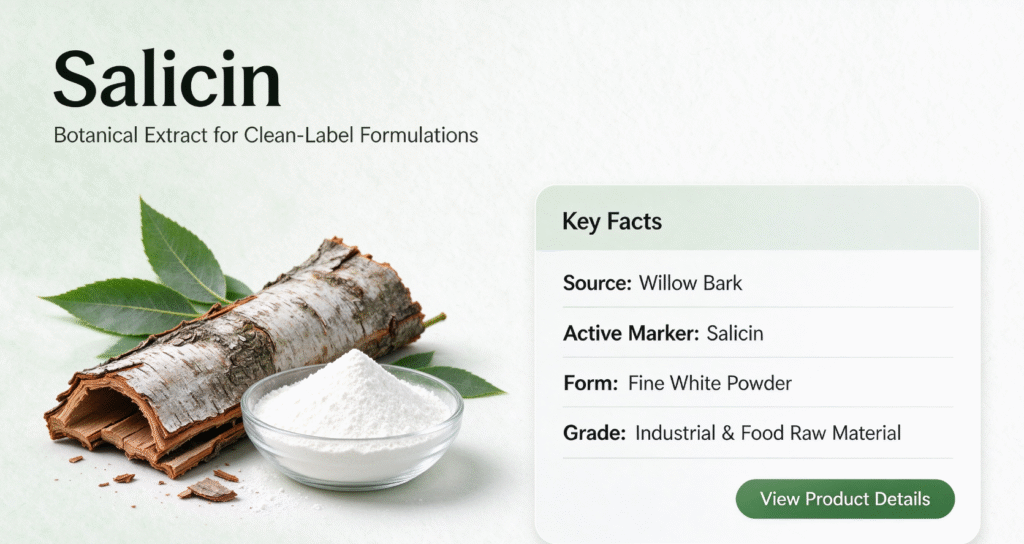
Typical specifications. Commercial grades are classified by salicin content. Standard grades typically contain 15% salicin, suitable for general pain relief supplements. Mid-grade products contain 25% salicin, offering a more concentrated active profile. Premium high-purity grades reach 50% salicin, delivering a focused active for clinical-use formulators and evidence-led brands.
Physical and chemical parameters. Salicin is a white to off-white crystalline powder, freely soluble in water and ethanol. It exhibits excellent stability under normal storage conditions and is compatible with common excipients used in capsule and tablet manufacturing.
Heavy metal limits. Lead ≤1ppm, Arsenic ≤1ppm, compliant with FCC and JECFA specifications.
Documentation support. For B2B buyers, complete documentation is essential: COA, MSDS, specification sheet, and third-party test reports covering heavy metals, microbials, and residual solvents, as well as non-GMO and allergen statements where applicable.
Application Scenarios and Formulation Strategies
Joint health supplements. The largest application category. Salicin is used in capsules, tablets, and powdered drink mixes targeting arthritis, joint discomfort, and inflammation. The key challenge is achieving a clinically effective dose while maintaining a manageable serving size. Common strategies include using higher-purity grades (25% or 50% salicin) to reduce capsule count, and blending with other joint-health ingredients such as glucosamine, chondroitin, or turmeric extract.
Pain relief and sports recovery. Salicin is used in products targeting low back pain, menstrual cramps, and muscle soreness after exercise. The prodrug mechanism offers a gentler alternative to conventional NSAIDs, appealing to consumers seeking natural options with fewer gastrointestinal concerns.
Skin brightening cosmetics. Emerging application. Salicin’s anti-melanogenic activity, demonstrated through TRP-1 and TRP-2 downregulation, positions it as a promising natural ingredient for brightening serums, creams, and lotions. Formulators can combine salicin with other whitening agents such as niacinamide, arbutin, or vitamin C for multi-target brightening systems.
Tabletop and functional foods. Salicin can be incorporated into functional beverages and foods targeting inflammation and joint health, though taste considerations may require masking strategies.
Safety and Regulatory Considerations
Salicin and willow bark extract have a favorable safety profile, but important caveats apply.
Toxicity data. An in vivo study examining the genotoxic potential of Salix alba bark extract administered orally to mice at doses of 500, 1000, and 2000 mg/kg body weight for seven days found no significant DNA damage in peripheral blood leukocytes, liver, bone marrow, heart, or testicular cells, and no clastogenic or aneugenic effects as detected by micronucleus testing. These findings support the safety of willow bark extract at commonly used doses.
Precautions. Individuals allergic to aspirin or salicylates should avoid willow bark products. It should not be given to children with viral infections due to a theoretical risk of Reye syndrome. Those with kidney disease should also avoid it. While breastfeeding, willow bark is best avoided as salicylates are excreted into breastmilk.
Drug interactions. Willow bark may interact with anticoagulants (such as warfarin), other NSAIDs, and medications metabolized by the liver. Patients taking these medications should consult a healthcare provider before use.
Regulatory implications for B2B buyers. Regulatory status varies by market. In the United States, willow bark extract is regulated as a dietary supplement ingredient. In Europe, the EMA monograph provides a recognized framework for standardized willow bark extract products. Product labels and claims should strictly comply with local regulations.
Why Choose Our Salicin?
As a professional botanical extract supplier, we offer salicin products that meet B2B buyer requirements:
Multiple grades for diverse applications. From standard 15% salicin for cost-sensitive applications to high-purity 50% grades for clinical-use formulators, we provide specification options to match your formulation and budget.
Complete documentation support. Every shipment includes COA, MSDS, specification sheet, and third-party test reports covering heavy metals, microbials, and residual solvents.
Flexible supply. Minimum order quantities as low as 1 kg for trial orders, with scalable pricing for commercial volumes.
Salicin is not a trend ingredient — it is a plant-derived compound with decades of clinical research, well-characterized mechanisms of action, and broad application prospects. For formulators building joint health supplements, natural pain relief products, or skin-brightening cosmetics, it deserves serious evaluation — but only with a clear understanding of its dosing challenges and formulation strategies.
Ready to try Salicin for your business? Contact us at info@xianherb.com for a free sample or wholesale price list.
Leave A Comment