
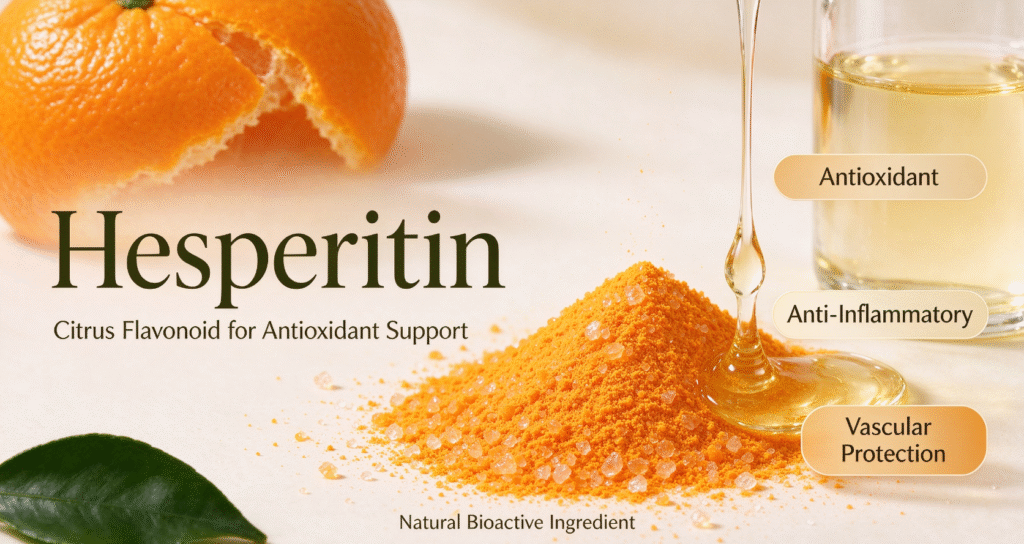
In the evolving landscape of plant-based bioactive compounds, few molecules bridge traditional citrus wisdom and modern nutritional science as effectively as hesperetin. As the primary flavonoid aglycone found abundantly in citrus fruits, this versatile compound has transitioned from academic investigation to a commercially significant ingredient in the global antioxidant, cardiovascular support, and healthy aging markets. For formulators, supplement brands, and B2B buyers seeking evidence-backed botanical solutions, hesperetin offers a rare combination: a well-characterized mechanism of action, a growing body of research, and a supply chain rooted in Asia-Pacific botanical extraction capabilities.
What Is Hesperetin?
Hesperetin (C₁₆H₁₄O₆) is a naturally occurring flavanone classified chemically as 3‘,5,7-trihydroxy-4’-methoxyflavanone. It exists in citrus fruits primarily in the form of hesperidin (the glycoside), which releases hesperetin upon hydrolysis. The compound is most abundantly sourced from the peel and pulp of citrus fruits such as oranges, lemons, and grapefruits.
From a chemical perspective, hesperetin is a light yellow to off-white crystalline powder with a molecular weight of approximately 302.28 g/mol and a CAS number of 520-33-2. It is practically insoluble in water, soluble in dimethyl sulfoxide (DMSO) and ethanol, and soluble in dilute alkali with a yellow coloration. Commercial hesperetin products are typically offered as high-purity extracts (≥98% by HPLC) for pharmaceutical and research applications, or as standardized citrus flavonoid extracts for cost-sensitive nutraceutical formulations. The compound is also increasingly available in water-soluble formulations (such as α-glucosyl hesperidin) designed to address its well-documented bioavailability challenges.
Mechanism of Action: A Multi-Target Flavonoid
Unlike synthetic antioxidants that act through a single pathway, hesperetin exerts its biological effects through a network of interconnected mechanisms. This multi-target profile is critical for formulators developing products for cardiovascular support, metabolic wellness, and healthy aging.
Antioxidant and free radical scavenging activity. Hesperetin possesses potent direct free radical scavenging activity while also modulating endogenous antioxidant defense systems. It has been shown to upregulate antioxidant enzymes such as superoxide dismutase (SOD) and catalase, and to inhibit lipid peroxidation, thereby protecting cellular structures from oxidative stress.
Vascular and capillary support. Hesperetin is recognized for its ability to support vascular integrity and capillary function. Research indicates that it helps maintain normal endothelial function and microcirculation, which is central to its observed benefits in vein health and cardiovascular wellness.
Anti-inflammatory pathway modulation. Hesperetin regulates key inflammatory signaling cascades, including the NF-κB and MAPK pathways. By inhibiting the activation of these pathways, hesperetin reduces the expression of pro-inflammatory cytokines such as TNF-α and IL-6, thereby attenuating chronic low-grade inflammation associated with metabolic stress and aging.
Metabolic regulation and lipid metabolism. Recent research has identified hesperetin as a modulator of lipid metabolism. Studies demonstrate that hesperetin activates AMPK signaling and regulates PPARα, enhancing fatty acid oxidation and reducing lipid accumulation in hepatocytes. This mechanism positions hesperetin as a promising ingredient for metabolic health and weight management formulations.
Neuroprotective potential. Hesperetin has demonstrated the ability to cross the blood-brain barrier and exert neuroprotective effects. Preclinical studies indicate that it protects neural cells from oxidative stress and neuroinflammation by modulating BDNF signaling and reducing amyloid-beta-induced toxicity, making it a subject of interest for cognitive health research.
Clinical Evidence: What the Research Shows
For B2B buyers evaluating hesperetin for product development, understanding the research evidence base is essential for accurate positioning and compliant claim substantiation.
Cardiovascular and metabolic health. Clinical studies on citrus flavonoid supplementation have demonstrated favorable effects on biomarkers of cardiovascular health, including improvements in endothelial function, reduction in oxidative stress markers, and support for healthy lipid profiles. These findings provide a strong foundation for cardiovascular and metabolic wellness applications.
Venous and capillary health. Hesperetin, often in combination with diosmin, has been extensively studied in the context of chronic venous insufficiency and capillary fragility. Clinical trials support its role in maintaining vascular tone and reducing symptoms associated with poor microcirculation, such as leg heaviness and discomfort.
Cognitive and neuroprotective research. Emerging preclinical research suggests that hesperetin may support cognitive function through its antioxidant and anti-inflammatory effects in neural tissue. While human clinical trials are still limited, the mechanistic evidence provides a strong rationale for further investigation in cognitive health applications.
Bioavailability enhancement. The glycosylation of hesperetin (as α-glucosyl hesperidin) has been clinically shown to significantly improve absorption and plasma concentration compared to unmodified hesperidin. This bioavailability advantage is a key selling point for formulators seeking to maximize the efficacy of their products.
Market Landscape: A Growing Global Opportunity
The global citrus flavonoid market is experiencing robust growth, driven by rising consumer awareness of plant-based health solutions and the expanding nutraceutical sector.
Market size and growth. The market for citrus flavonoids, including hesperidin and hesperetin, is projected to grow steadily, driven by increasing demand for natural antioxidants and cardiovascular health ingredients. The healthy aging and women‘s health segments represent particularly dynamic growth areas.
Application segments. The market is segmented into several primary application categories:
-
Nutraceuticals and dietary supplements: The largest application segment, driven by growing consumer demand for natural solutions for cardiovascular health, vein support, and healthy aging.
-
Functional foods and beverages: An emerging segment incorporating hesperetin into fortified foods and beverages for enhanced wellness, particularly water-soluble derivatives like α-glucosyl hesperidin.
-
Cosmeceuticals and personal care: A growing segment leveraging hesperetin’s antioxidant and anti-aging properties for skin care formulations.
-
Pharmaceuticals: The second-largest segment, with hesperetin‘s potential in metabolic disorders and vascular health driving research and development investment.
Consumer trends. The growing interest in phytoflavonoid-based solutions for cardiovascular health, “clean label” ingredient sourcing, and preventive health approaches continues to drive demand for hesperetin. Its established presence in traditional citrus-based diets and its GRAS-adjacent regulatory status in key markets make it particularly attractive for brands targeting healthy aging and metabolic wellness demographics.
Product Specifications and Quality Control
As a B2B ingredient, the value of hesperetin lies in purity standardization, batch-to-batch consistency, and contaminant control.
Typical specifications. High-purity hesperetin is available at ≥98% (HPLC) for pharmaceutical and research applications. Standardized citrus flavonoid extracts typically contain defined hesperetin content alongside other flavonoids including hesperidin and naringenin. The product is typically a light yellow to off-white crystalline powder, soluble in DMSO and ethanol, and practically insoluble in water.
Quality control considerations. Inconsistent hesperetin content between batches is a common challenge in botanical extract sourcing. Best practices include rigorous HPLC-based quantification of hesperetin and other flavonoid components. Third-party testing for heavy metals (lead, arsenic, mercury, cadmium), microbials, pesticide residues, and residual solvents is essential.
Documentation support. Complete documentation includes Certificate of Analysis (COA), Material Safety Data Sheet (MSDS), specification sheet, and third-party test reports. For products targeting regulated markets, additional documentation may include GMP certificates and ISO certifications where applicable.
Why Choose Xi‘an Herb Bio-Tech Hesperetin?
As a professional botanical extract supplier, Xi’an Herb Bio-Tech Co., Ltd offers hesperetin and citrus flavonoid extract products that meet the rigorous requirements of B2B buyers:
Multiple grades for diverse applications. From high-purity hesperetin (≥98%) for pharmaceutical and research applications to standardized citrus flavonoid extracts and water-soluble α-glucosyl hesperidin for cost-sensitive nutraceutical formulations, we provide specification options to match your formulation and budget requirements.
Complete documentation support. Every shipment includes COA, MSDS, specification sheet, and third-party test reports covering heavy metals, microbials, and residual solvents. Our quality control processes are aligned with standard analytical methods for flavonoid quantification.
Flexible supply. Minimum order quantities as low as 1 kg for trial orders, with scalable pricing for commercial volumes. We support custom packaging and labeling to meet your brand requirements.
Stable supply chain. Leveraging our established network of citrus cultivation partners and our own production capabilities, we ensure consistent availability and batch-to-batch reproducibility—critical for brands maintaining product quality across production runs.
Ready to try Hesperidin for your business? Contact us at info@xianherb.com for a free sample or wholesale price list.
Leave A Comment