
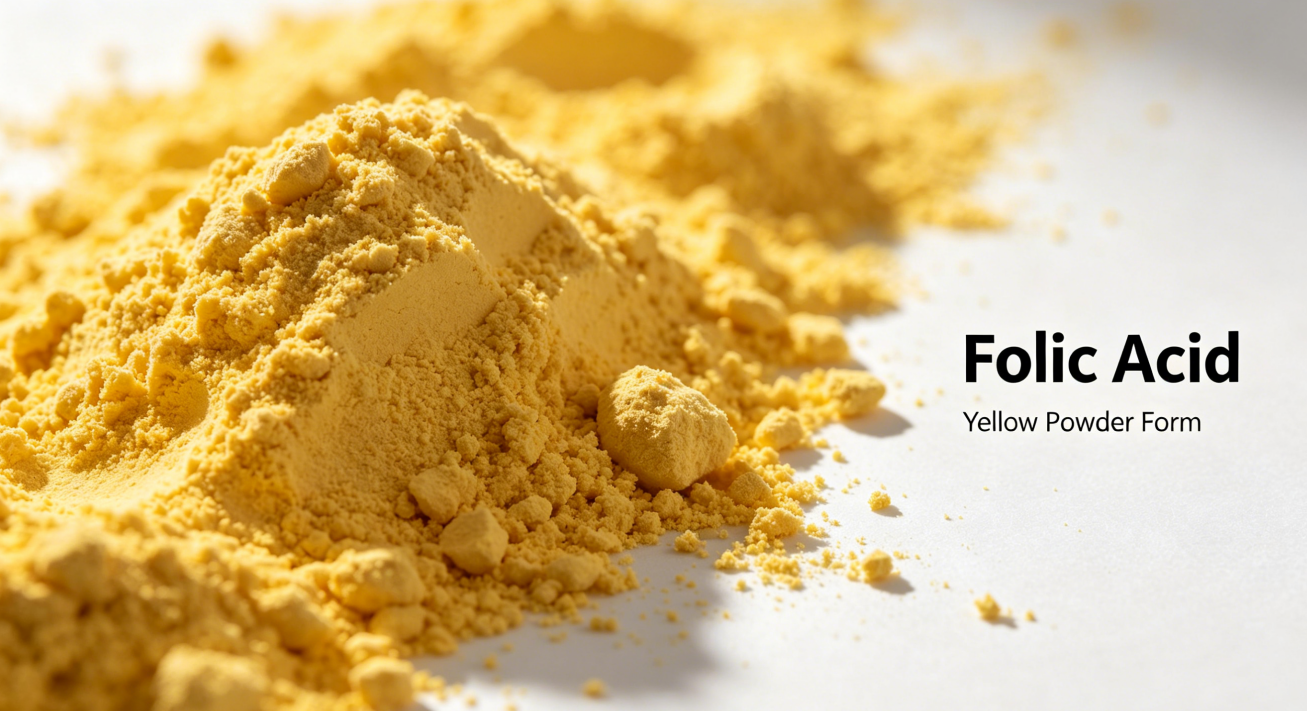
What Is Folic Acid? Basic Introduction & Core Properties
Folic acid is a synthetic water-soluble vitamin B9 widely used in food fortification, healthcare supplements, and pharmaceutical formulations worldwide.
Often confused with folate, the natural form of vitamin B9 found in leafy greens, beans, and fruits, folic acid is a laboratory-synthesized variant with higher stability and bioavailability. Unlike natural folate, synthetic folic acid resists degradation during food processing and long-term storage, making it a preferred ingredient for industrial mass production. Since 1998, many countries have mandated folic acid fortification in flour, cereals, bread, and pasta to eliminate public folate deficiency. It serves as a core coenzyme for human DNA synthesis, cell division, and amino acid metabolism, laying a foundation for its extensive applications in health care and food manufacturing. For B2B buyers, understanding its grade specifications and chemical properties is essential for matching suitable bulk materials for food, pharmaceutical, or nutraceutical production.

Key Benefits & Main Uses of Folic Acid
Folic acid delivers comprehensive health benefits and covers diverse commercial application scenarios, covering personal healthcare and industrial raw material utilization. The most recognized value lies in prenatal health care, which closely answers how to use folic acid for pregnancy, one of the most searched user questions.
For prenatal use, standardized folic acid supplementation effectively reduces the risk of fetal neural tube defects, spina bifida, and cleft palate. Clinical guidelines recommend 400 to 800 mcg daily intake for women before conception and in early pregnancy, while high-risk groups can take 4000 to 5000 mcg under professional guidance. Beyond prenatal care, folic acid improves folate deficiency anemia, lowers excessive homocysteine levels to reduce stroke and cardiovascular risks, and assists in adjuvant treatment for depression when combined with antidepressants. It also helps alleviate side effects of certain chemotherapy drugs and improves cognitive decline in elderly groups with abnormal mental deterioration.
Commercially, high-purity folic acid is a versatile raw material for food fortification, dietary supplements, pharmaceutical preparations, and animal feed. Its stable chemical properties enable seamless integration into various processed foods, multivitamin supplements, and healthcare products, making it a staple stock item for global ingredient distributors and manufacturers.
Typical Folic Acid Product Specification Overview
This specification overview summarizes the key quality parameters for high-purity folic acid, which is the most popular grade in the B2B market. The product is a synthetic, water-soluble vitamin B9 in the form of a fine, yellow to orange-yellow crystalline powder, characterized by its high stability, low impurity profile, and wide compatibility with various food and nutraceutical production processes.
The core quality indicator is its purity (assay) , which for pharmaceutical and high-end food grades typically complies with international standards such as the United States Pharmacopeia (USP) or the European Pharmacopoeia (Ph. Eur.). This purity is determined using High-Performance Liquid Chromatography (HPLC) and generally exceeds 98.0% on the dried basis.
To ensure stability, the product’s loss on drying (moisture content) is strictly controlled, typically to below 8.5% as per USP guidelines. The residue on ignition (sulfated ash) is also limited to a low percentage, commonly not exceeding 0.5%, indicating a high degree of purity and low inorganic contaminants.
For safety and regulatory compliance, the product undergoes rigorous testing for heavy metals. Limits are strictly set for lead (Pb), arsenic (As), and mercury (Hg), with each typically maintained at levels below 1.0 to 2.0 mg/kg, adhering to international food and pharmaceutical safety standards.
The product meets the quality requirements for both food grade and pharmaceutical grade applications. Food-grade folic acid complies with FDA and ISO certification standards, suitable for food fortification and regular dietary supplements, with strict limits on impurity content. Pharmaceutical-grade folic acid features the highest purity, complying with GMP and international pharmacopoeia standards, and is exclusively used in prescription drugs and high-end prenatal supplements. A feed grade is also available for animal nutrition.
Each batch of high-quality folic acid is accompanied by a complete Certificate of Analysis (COA), which verifies all the above parameters, including specific test results for purity, moisture, ash, and heavy metal content, ensuring full traceability and quality assurance for B2B buyers.
Potential Side Effects and Precautions of Folic Acid
Many buyers and end users wonder what are the side effects of folic acid, as safe dosage and usage directly determine product compliance and market applicability. Generally, folic acid is safe for daily use within recommended doses, but excessive or long-term intake will trigger adverse reactions.
Oral intake of no more than 1 mg daily is safe for most adults. Doses exceeding this standard may cause stomach upset, nausea, diarrhea, skin allergies, irritability, and even seizures in severe cases. Long-term high-dose supplementation (0.8–1.2 mg per day) may potentially increase cancer risks and worsen cardiovascular conditions in patients with existing heart disease. For special groups, pregnant and breastfeeding women must follow strict dosage limits: a maximum of 800 mcg for minors under 18 and 1000 mcg for adults to avoid fetal health risks.
In addition, folic acid has specific medication interactions. It accelerates the metabolism of anti-seizure drugs like fosphenytoin and phenobarbital, weakening their therapeutic effects. It also masks vitamin B12 deficiency symptoms, delaying diagnosis and causing permanent nerve damage if left untreated. People with cancer history and artery angioplasty recovery patients are advised to avoid high-dose folic acid to prevent condition deterioration. These safety precautions are critical for manufacturers to formulate product instructions and for distributors to provide professional customer guidance.
Folic Acid Grade Classification & Quality Standards
Commercial folic acid is divided into multiple grades based on purity, production standards, and application scenarios, forming a clear tiered market for B2B bulk trading. The mainstream categories include food grade, pharmaceutical grade, and feed grade, each with independent quality inspection systems and certification requirements.
Pharmaceutical grade folic acid features the highest purity, complying with GMP and international pharmacopoeia standards, and is exclusively used in prescription drugs and high-end prenatal supplements. Food grade folic acid meets FDA and ISO certification requirements, suitable for food fortification and regular dietary supplements, with strict limits on impurity content and heavy metal residues. Feed grade folic acid is tailored for animal breeding, with relatively relaxed indicators to meet livestock and poultry nutritional needs.
High-purity folic acid, the most popular specification in the B2B market, stands out for its high stability, low impurity, and wide compatibility. It adapts to most food and healthcare product production processes, with stable quality that reduces batch difference risks for downstream manufacturers. When sourcing bulk folic acid, professional grade judgment and quality verification are key to avoiding unqualified raw materials that cause product compliance problems.
Bulk & Wholesale Folic Acid Purchase Guide for B2B Buyers
Global manufacturers and distributors frequently ask where to buy high purity folic acid with stable quality, competitive pricing, and reliable after-sales service. For B2B buyers, bulk procurement of folic acid requires comprehensive consideration of product quality, supply capacity, cost performance, and service support.
First, prioritize suppliers with complete qualification certifications, including ISO, GMP, and food safety certifications, to ensure products meet regional market access standards. High-purity folic acid for food and pharmaceutical applications must provide complete test reports for each batch, including purity, moisture, residue, and heavy metal detection data. Second, pay attention to supply stability and MOQ rules. Formal bulk suppliers support flexible order quantities, conventional packaging customization, and stable spot inventory to meet continuous production needs of downstream factories.
In terms of cost, bulk wholesale prices are affected by purity grade, order quantity, and logistics methods. Long-term cooperative suppliers can provide customized pricing schemes and regular stock maintenance services. In addition, professional after-sales support, including product technical guidance, storage suggestions, and quality problem solving, is an important guarantee for stable long-term cooperation. Reliable suppliers can also provide sample testing services for buyers to verify product quality before bulk procurement.
How to Store and Maintain Folic Acid Bulk Raw Materials
For B2B buyers who stock and resell folic acid powder or use it for continuous production, proper storage is critical to preserving product efficacy, avoiding quality deterioration, and reducing operational losses. As a heat and moisture-sensitive vitamin ingredient, folic acid requires standardized warehousing conditions to maintain its original purity and stability throughout the entire inventory cycle.
Bulk folic acid powder should always be stored in a cool, dry, and well-ventilated warehouse environment, away from direct sunlight, high temperature, and high humidity. Sealed packaging must be kept intact during storage to prevent moisture absorption, caking, and oxidation. It is necessary to avoid mixed storage with strong oxidizing substances and chemical reagents, which may cause ingredient contamination and efficacy attenuation. For long-term bulk inventory, regular sampling and inspection are recommended to check for color change, agglomeration, and quality deviation.
In addition, standardized transportation and handling also affect final product quality. Professional suppliers adopt moisture-proof, dust-proof, and pressure-resistant packaging for wholesale orders, ensuring stable quality during long-distance shipping. Mastering correct storage and maintenance methods helps downstream manufacturers and distributors control product quality strictly, reduce waste, and ensure consistent production output.
Ready to try Folic Acid for your business? Contact us at for a free sample or wholesale price list.
Leave A Comment