
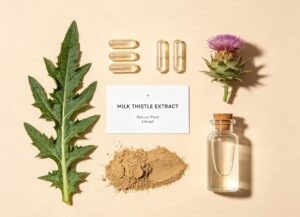
Global formulators and bulk buyers frequently ask what makes Milk Thistle Extract a must-have ingredient for commercial production. The answer lies in its unique flavonolignan complex—silymarin—which has made it one of the most rigorously studied botanical ingredients for liver health, metabolic wellness, and antioxidant formulations. With the global market valued at approximately USD 1.03 billion in 2026 and projected to reach USD 1.5 billion by 2030 at a CAGR of 9.9%, demand for high-quality, standardized milk thistle extract continues to grow across the nutraceutical, pharmaceutical, and functional food industries.
What Is Milk Thistle Extract?
Milk Thistle Extract is a concentrated botanical ingredient derived from the seeds of Silybum marianum (L.) Gaertn., a plant native to the Mediterranean region that has been used for over 2,000 years, primarily for liver support and hepatoprotection. The seeds contain approximately 60–80% silymarin, a complex mixture of flavonolignans and flavonoids including silybin A, silybin B, isosilybin A, isosilybin B, silychristin, silydianin, and taxifolin.
The key bioactive marker is silymarin, with commercial grades typically standardized to 80% silymarin by UV. However, the assay method matters significantly: the same powder can be “80% by UV” but approximately “30% by HPLC as silibinin”. For procurement professionals, this means always sourcing against a stated method and verifying the assay basis on every Certificate of Analysis (COA).
Core Specifications & Quality Grades
For professional buyers, the key specifications to verify are determined by silymarin content, purity, and intended application.
The 80% Standard – Industry Benchmark
The industry gold standard is 80% silymarin by UV, verified by HPLC for identity. The extract should appear as a yellow to yellowish-brown amorphous powder. Extraction typically uses ethyl acetate as the food-grade solvent, with residual solvent controlled to NMT 5,000 ppm (tested to USP <467>). Heavy metals (lead, arsenic, cadmium, mercury) should be tested by ICP-MS, and the extract should be non-ETO, non-irradiated, and GMO/BSE/TSE free.
Critical Quality Parameters
A 2019 study published in Scientific Reports raised serious concerns about the chemical and microbiological quality of commercial milk thistle supplements, finding that some products contained silymarin levels substantially different from label claims or were contaminated with pesticides, microorganisms, or mycotoxins. This underscores the importance of sourcing from suppliers who provide batch-specific COA documentation and third-party testing.
The UHPLC-MS/MS-based method of standard addition requires less than 10 minutes per injection and is suitable for the standardization of silymarin from milk thistle in support of preclinical and clinical studies. This method accounts for the complexity of the botanical matrix, where suppression or enhancement of MS signals can occur when using electrospray.
Application-Specific Grades
Not all 80% extracts are the same. Depending on your application, you may need different grades:
- Standard Extract (80% by UV): Cost-effective, fully compliant with USP standards. Best suited for capsules and tablets.
- HPLC-Standardized Extract: Provides detailed constituent control with verified levels of individual flavonolignans (silybin A, silybin B, etc.). Essential for formulations requiring precise fingerprinting.
- Water-Dispersible Grade: Formulated for beverages and liquid applications. Conventional silymarin-rich extracts should not automatically be described as fully water-soluble—solubility, dispersibility, and suspension are different properties that should be evaluated under intended processing conditions.
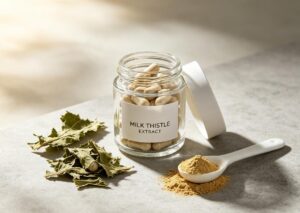
Applications & Industrial Value
Milk Thistle Extract is a versatile ingredient with applications spanning multiple industries:
Dietary Supplements & Nutraceuticals
Milk thistle extract is most commonly used in liver health, detoxification, and antioxidant formulations. It is available in capsules, tablets, and powder sachets, with typical dosages ranging from 100 to 500 mg per serving of standardized extract. It is often combined with other liver-support ingredients such as artichoke extract, dandelion root, or turmeric for synergistic blends.
Metabolic Health & Weight Management
Emerging research has identified additional application areas for silymarin-enriched milk thistle extract. A 2025 study published in the journal Agris (FAO) demonstrated that a silymarin-enriched extract from milk thistle increases systemic energy expenditure, preserves body temperature after cold exposure, improves insulin resistance, and reduces inflammatory markers in white adipose tissue in a preclinical model of high-fat-diet-induced obesity. The study suggests that the extract may be proposed as a nutraceutical for the management of metabolic chronic diseases and accelerated aging. This positions milk thistle extract as a promising ingredient in the growing metabolic wellness segment.
Functional Foods & Beverages
Water-dispersible grades enable easy incorporation into ready-to-drink formats, wellness shots, and fortified beverages. For beverage applications, it is essential to test the actual proposed commercial sample under intended processing conditions for dispersion, sedimentation, and stability.
Cosmetics & Personal Care
Milk thistle extract’s antioxidant properties support its use in anti-aging and skin-protective formulations.
Choosing the Right Specification
There is no universally “best” milk thistle extract powder. The correct grade depends on the formulation and quality objective:
For general concentrated botanical formulation – a ratio extract may be appropriate.
For defined silymarin potency – a standardized extract is essential.
For detailed constituent control – a chromatographic specification (HPLC) is preferred.
For capsule manufacturing – review assay, bulk density, flow, and dose mass.
For tablet manufacturing – review particle size, flow, and compressibility.
For powder blends – review uniformity and segregation risk.
For beverage application – test dispersibility, sedimentation, and stability.
For organic positioning – verify product-specific certification and traceability.
For repeat commercial production – prioritize assay consistency and change control.
Common Adulteration Risk
The most common milk thistle adulteration is substitution or cutting with cheaper thistles that carry little or no silymarin. Confirming identity on incoming seed—not just on the finished powder—closes that gap early. Reputable suppliers verify identity through HPLC fingerprinting to ensure the correct flavonolignan profile.
Safety & Regulatory Status
Milk thistle extract, when taken orally, appears to be well tolerated. The most common side effects are digestive symptoms such as bloating, nausea, and gas.
Safety Considerations:
- Allergies: May cause allergic reactions, particularly among people who are allergic to related plants (ragweed, chrysanthemum, marigold, daisy).
- Diabetes: May lower blood sugar in people with type 2 diabetes—use with caution and monitor blood sugar levels.
- Drug interactions: May affect cytochrome P450 2C9 substrates (diazepam, warfarin), diabetes medications, raloxifene, simeprevir, and sirolimus.
- Pregnancy/Breastfeeding: Little is known about whether it’s safe to use milk thistle during pregnancy or while breastfeeding.
- Hormone-sensitive conditions: May affect estrogen levels—avoid in breast cancer, uterine cancer, ovarian cancer, endometriosis, or uterine fibroids.
Why Choose Our Milk Thistle Extract
As a professional milk thistle extract manufacturer, we offer high-quality, standardized extracts with:
80% Silymarin Standardization: Guaranteed 80% by UV, verified by HPLC identity
Low Residual Solvent: Ethyl acetate controlled to NMT 5,000 ppm
Full Traceability: Complete COA documentation with heavy metals, microbiology, and residual solvent testing
Multiple grades: Standard USP, HPLC-standardized, and water-dispersible grades
Flexible supply: From 1 kg trial orders to full container shipments
GMP-certified production: ISO, Halal, and Kosher certifications available
Regulatory support: Comprehensive documentation for global regulatory submissions
Ready to try Milk Thistle Extract for your business? Contact us at info@xianherb.com for a free sample or wholesale price list.
Leave A Comment