
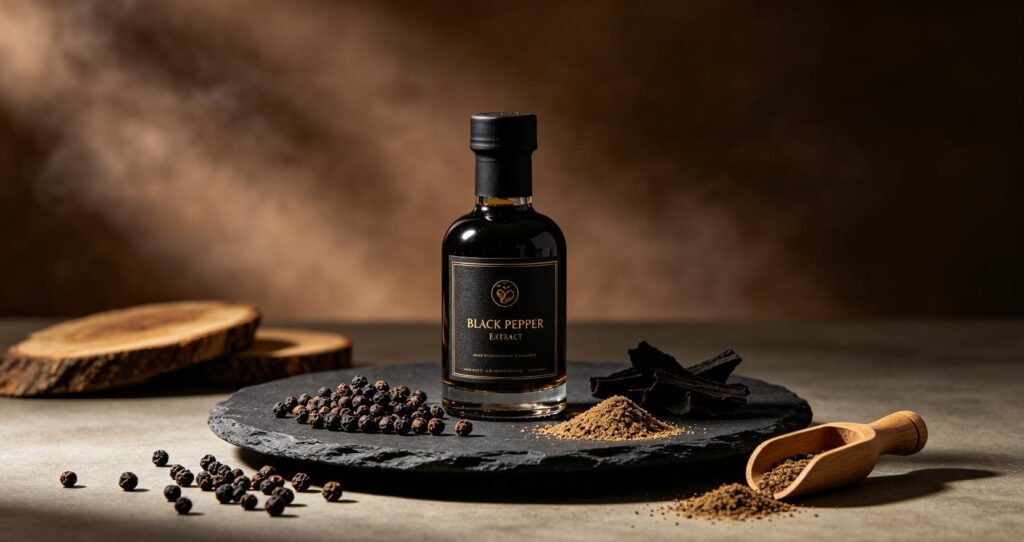
 Black pepper (Piper nigrum) has been valued in traditional medicine systems for centuries, not only as a culinary spice but also for its preservative and medicinal properties . Modern research has focused on piperine, the alkaloid responsible for pepper‘s pungent taste and much of its biological activity. Piperine is now studied extensively for its ability to enhance the absorption of other compounds, making it a uniquely valuable ingredient in supplement and nutraceutical formulations.
What Is Black Pepper Extract?
Black pepper extract is a concentrated botanical ingredient derived from the berries of Piper nigrum, standardized to piperine content. Piperine is the primary bioactive alkaloid, typically constituting 95% or more of the alkaloid fraction in commercial extracts . The extract is available in various standardized grades, with common specifications ranging from 50% to 98% piperine content, verified by HPLC.
The ingredient is widely used not as a standalone therapeutic but as a “bioenhancer”—a compound that improves the absorption and systemic availability of co-administered nutrients, botanical extracts, and pharmaceutical agents .
The Bioenhancing Mechanism
The defining characteristic of piperine is its multifaceted effect on drug and nutrient metabolism. Research has identified several mechanisms through which piperine enhances bioavailability .
First, piperine inhibits cytochrome P450 enzymes, particularly CYP3A4, which are responsible for the first-pass metabolism of many compounds in the liver and intestinal wall. By slowing this metabolic breakdown, piperine allows co-administered substances to remain in the bloodstream longer and at higher concentrations . A physiologically based pharmacokinetic modeling study predicted that a 7-day intake of 20 mg/day piperine could increase the AUC of simvastatin by 59%, cyclosporine by 35%, and nifedipine by 34% .
Second, piperine inhibits P-glycoprotein, an efflux transporter that actively pumps compounds out of cells and back into the intestinal lumen. By blocking this efflux mechanism, piperine increases intestinal absorption of substances that would otherwise be poorly absorbed .
Third, piperine modulates intestinal permeability by altering membrane dynamics, further supporting absorption .
These combined mechanisms explain why piperine has been studied as a co-ingredient with curcumin, CoQ10, beta-carotene, and various botanical extracts to improve their clinical performance .
Research on Piperine’s Physiological Effects
Beyond its bioenhancing role, piperine itself has been studied for a range of physiological effects. A comprehensive review published in 2021 summarized piperine‘s biological effects, noting its antioxidant, anti-inflammatory, immunomodulatory, and neuroprotective properties in preclinical studies .
In a randomized, double-blind, placebo-controlled trial involving patients with non-alcoholic fatty liver disease and early cirrhosis, researchers investigated the effects of 5 mg piperine daily for 12 weeks. The study reported that piperine was associated with decreased hepatic enzymes and glucose levels, and reduced insulin resistance compared to placebo .
Piperine has also been studied in combination with curcumin in clinical trials. A randomized controlled trial in COVID-19 outpatients used capsules containing 500 mg curcumin plus 5 mg piperine, exploring the effects of this combination on clinical symptoms and inflammatory factors .
However, a 2025 review on piperine and cancer noted that while piperine has demonstrated anticancer mechanisms in laboratory studies, clinical trials in cancer patients have not yet been conducted. The authors emphasized that most data remain preclinical and that future well-designed clinical trials are needed .

Product Specifications
Black pepper extract is available in multiple standardized grades. Common commercial specifications include 50%, 95%, and 98% piperine content, verified by HPLC. The extract typically appears as a light yellow to off-white fine powder with a characteristic pungent odor. Particle size is generally 80–100 mesh, with custom sizes available.
Heavy metal limits should be below 10 ppm, and microbial counts should meet USP or EP standards. The ingredient is water-soluble to a limited extent; for beverage applications, water-dispersible or microencapsulated forms are available.
Applications in Dietary Supplements
Black pepper extract is most commonly used in dietary supplement formulations as a bioavailability enhancer. It is included in curcumin supplements, CoQ10 products, multivitamins, and botanical blends to improve the absorption of the primary active ingredients . Typical usage levels are 5–20 mg per serving, corresponding to approximately 5–10 mg piperine.
The ingredient is also used in sports nutrition and weight management formulations, often combined with green tea extract, capsaicin, or other thermogenic compounds.
Safety and Regulatory Considerations
Piperine is generally recognized as safe when consumed as part of food. However, the concentrated extract requires caution in certain applications.
A key safety concern is drug interaction. Because piperine inhibits CYP3A4 and P-glycoprotein, it can significantly alter the pharmacokinetics of medications with narrow therapeutic indices. The PBPK modeling study specifically recommended caution when consuming amounts of black pepper equivalent to 20 mg/day piperine during treatment with CYP3A4 substrate drugs . A 2025 review also noted that piperine exhibits dose-dependent toxicity concerns, including reproductive and hepatic considerations, and emphasized the need for regulatory evaluation .
For B2B buyers, this means that products containing black pepper extract should carry appropriate warnings regarding potential drug interactions, particularly for formulations intended for consumers taking prescription medications.
Why Choose Our Black Pepper Extract
As a professional botanical extract supplier, we offer high-purity black pepper extract standardized to 95% and 98% piperine content, verified by HPLC. Our products are manufactured under GMP-certified conditions with full documentation including COA, MSDS, and third-party test reports for heavy metals, microbials, and residual solvents.
We support flexible MOQs for both small trial orders and large-scale bulk procurement. Custom specifications, including water-dispersible grades for beverage applications, are available upon request.
Ready to try Black Pepper Extract for your business? Contact us at info@xianherb.com for a free sample or wholesale price list.
Leave A Comment