
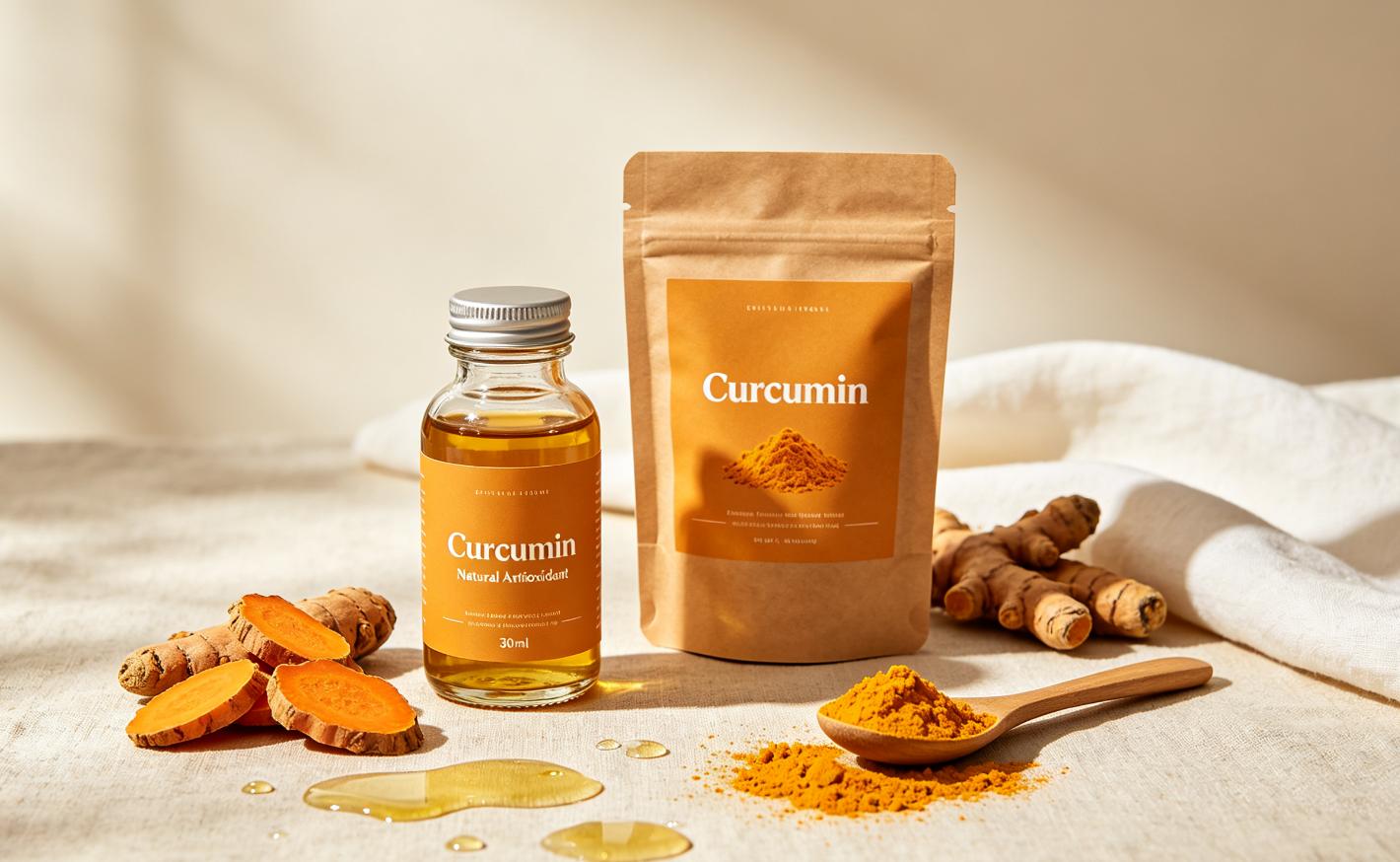
Global buyers and formulators frequently ask what makes curcumin a must-have ingredient for commercial production. The answer lies in its proven biological activities—anti-inflammatory, antioxidant, and antithrombotic properties that have been validated through decades of scientific research . As a result, curcumin has become one of the most sought-after natural ingredients across the dietary supplement, functional food, cosmetic, and pharmaceutical industries.
What Is Curcumin?
Curcumin is the primary bioactive polyphenolic compound found in turmeric (Curcuma longa), a plant native to Southeast Asia that has been used in traditional medicine for over 4,000 years . It is responsible for turmeric’s characteristic golden-yellow color and its wide range of health-promoting properties. The compound has a molecular weight of 368.39 g/mol and a chemical formula of C₂₁H₂₀O₆ .
In commercial production, curcumin is available as a standardized extract, typically containing a mixture of three curcuminoids: curcumin (the most abundant), demethoxycurcumin, and bisdemethoxycurcumin . High-quality commercial grades are standardized to ≥90% total curcuminoids with low solvent residue (≤50 ppm) and good flowability .
Market Overview & Supply Chain Insights
The global curcumin market is extensive, with trade coverage spanning 136 countries and over 1,489 companies (686 exporters and 803 importers) actively participating in the supply chain . India is the dominant supplier, exporting over 18,857 metric tons valued at nearly $540 million in 2024 . Other major exporting countries include the United States, Spain, Germany, Italy, and the Netherlands .
For buyers sourcing from China, the country ranks as a significant supplier to key markets like Germany, where it was the 4th largest origin supplier in 2024 . China’s unit prices for curcumin have varied between $2.52 and $88.89 per kg depending on purity and specification .
Main Applications & Uses of Curcumin
Dietary Supplements: Curcumin is most commonly used in joint health, cardiovascular support, and anti-inflammatory formulations. Typical dosages range from 100 to 500 mg per serving of standardized extract, though higher doses may be used in specific applications.
Functional Foods & Beverages: Curcumin is widely used as a natural food coloring (E100) in rice, mustards, sauces, and dairy products . It also serves as a natural antioxidant and antibacterial agent in food preservation, replacing synthetic alternatives .
Cosmetics & Personal Care: The anti-inflammatory, antioxidant, and anti-aging properties of curcumin make it increasingly popular in skincare formulations targeting photodamage, aging signs, and acne-prone skin .
Pharmaceutical Applications: Curcumin-based formulations account for more than 50% of the global anticancer drug market , with ongoing research into its potential for treating cardiovascular, neurological, and metabolic disorders.
Bioavailability Challenges & Solutions
Curcumin’s therapeutic potential has historically been limited by poor bioavailability: low water solubility (0.6 µg/mL), rapid metabolism, and quick systemic clearance . To address these challenges, innovative delivery systems have been developed:
- Liposomal Curcumin: Encapsulates curcuminoids in phospholipid vesicles, achieving plasma concentrations up to 27 times higher than conventional formulations .
- Piperine Combination: The addition of black pepper extract (piperine) enhances absorption.
- Advanced Encapsulation Technologies: Microencapsulation improves solubility and stability against heat, light, oxygen, and alkaline pH .
Regulatory & Safety Status
Curcumin is approved as a food additive (E100) by the World Health Organization, the U.S. Food and Drug Administration, and many other countries . It is generally recognized as safe (GRAS) for use in food and supplements.
However, buyers should be aware that microbial production of curcumin is emerging as a sustainable alternative to traditional farming, addressing concerns about deforestation, soil degradation, and water use . Suppliers offering microbial-derived curcumin may provide a competitive advantage in markets prioritizing sustainability.
As a professional curcumin manufacturer, we offer high-quality, standardized extracts with:
- Total curcuminoid content ≥90% (HPLC-verified)
- Low solvent residue ≤50 ppm
- Excellent flowability and bulk density
- Competitive pricing with flexible MOQ starting from 1kg
- Complete COA documentation and third-party test reports
Our products are available in conventional and organic grades, with custom specifications to meet your formulation needs.
Ready to try Curcumin for your business? Contact us at info@xianherb.com for a free sample or wholesale price list.
Leave A Comment