
In the world of natural medicine and botanical ingredients, few plants carry as much historical weight and modern relevance as white willow. While the willow tree is synonymous with traditional pain relief, the concentrated White Willow Bark Extract is increasingly finding its way into a wide range of nutraceutical, functional food, and personal care products.
For formulators and bulk buyers looking for a versatile, high-value ingredient, White Willow Bark Extract offers a unique combination of analgesic properties, anti-inflammatory activity, and emerging applications in skin health and beyond that make it a compelling choice for commercial product development.
What Is White Willow Bark Extract?
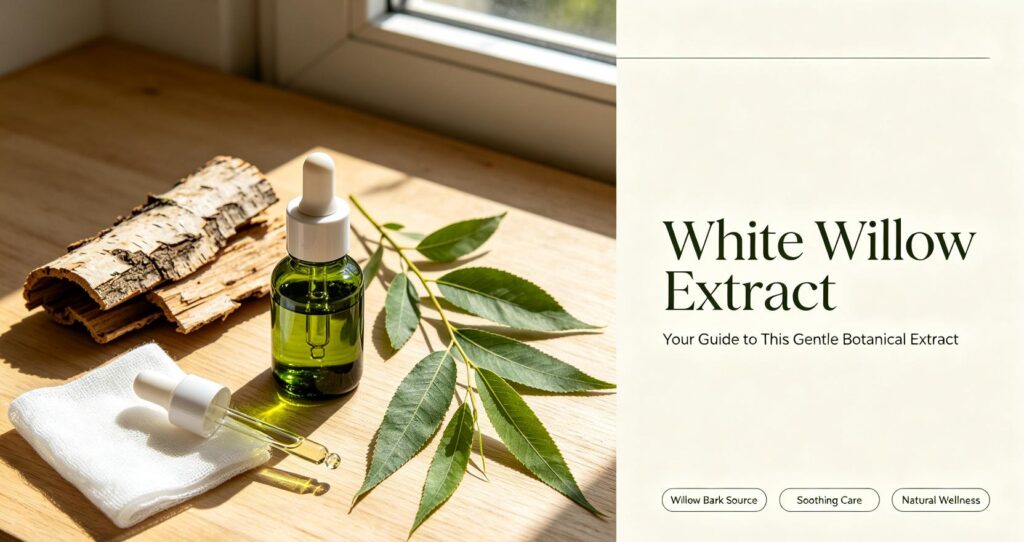
White Willow Bark Extract is a concentrated botanical ingredient derived from the bark of the white willow tree, Salix alba, a deciduous tree native to Europe and Central Asia. The extract is prized for its rich profile of bioactive compounds, with the key constituent being:
Salicin: The primary active compound, a phenolic glycoside that the body converts to salicylic acid. This conversion is responsible for the extract’s characteristic pain-relieving and anti-inflammatory properties. Salicin is considered a precursor to aspirin, though it offers a gentler, more sustained action due to its gradual metabolism .
Polyphenols and Flavonoids: Including gallic acid, catechin, rutin, and kaempferol, which contribute antioxidant and anti-inflammatory effects .
Tannins: Astringent compounds that may provide additional therapeutic benefits and support skin health.
The extract typically appears as a fine, light brown to white powder, depending on the extraction method and standardization. In commercial production, it is available in various forms tailored for different applications, from standardized salicin extracts to water-soluble grades for topical use.
Core Specifications and Quality Grades
For professional buyers, understanding the specification landscape is crucial for selecting the right product for your specific application.
The salicin content is the primary marker for quality and application, typically ranging from 15% to 99% as determined by HPLC . This standardization ensures consistent potency and predictable therapeutic effects. For cosmetic applications, water-soluble grades are available that contain butylene glycol and water along with the willow bark extract, designed for easy incorporation into serums and creams .
Quality control parameters such as loss on drying should remain below 5.0% to ensure product stability, while heavy metal limits must meet USP and EP standards for safety in dietary supplements and food applications . Microbiological safety including total plate count, yeast, mold, E. coli, and Salmonella testing is essential for regulatory compliance .
Application-Specific Grades
Depending on your industry, you may require different grades of White Willow Bark Extract:
Standardized Salicin Extracts are standardized to salicin content (typically 15%, 25%, or higher) and are ideal for use in dietary supplements targeting pain relief and inflammation. These grades provide consistent dosing and reliable therapeutic effects .
Water-Soluble Cosmetic Grades are designed for personal care applications, where the extract can be easily incorporated into aqueous formulations for skin-soothing and anti-aging products .
Ratio Extracts (e.g., 4:1 to 20:1) offer a more traditional botanical profile and are suitable for products where the full spectrum of willow bark compounds is desired.
Core Benefits of White Willow Bark Extract
Beyond its traditional role in pain relief, white willow bark extract has been increasingly studied for a range of biological effects that align with modern wellness trends.
For Pain Relief and Inflammation
Perhaps the most well-known application of white willow is for pain relief. Clinical studies suggest white willow bark may help reduce lower back pain, osteoarthritis pain, and headaches. A systematic review found that standardized willow bark extracts containing 120–240 mg of salicin daily showed significant pain reduction compared to placebo in several controlled trials . In a four-week, double-blind, placebo-controlled study of 210 individuals with back pain, 39% of those receiving the higher dose (240 mg salicin daily) were pain-free for at least five days of the final week, compared to only 6% in the placebo group .
The anti-inflammatory effects are attributed to salicin’s conversion to salicylic acid, which inhibits cyclooxygenase (COX) enzymes, particularly COX-2, reducing the production of inflammatory prostaglandins . Unlike synthetic aspirin, white willow bark contains numerous other compounds including flavonoids and tannins that may contribute to its therapeutic effects, potentially providing a gentler action with fewer gastrointestinal side effects .
For Fever Reduction and Immune Support
Traditional use supports white willow bark for fever reduction, and its salicin content theoretically supports this application . While modern clinical evidence for antipyretic effects is more limited compared to established fever reducers, the extract continues to be used in traditional medicine systems for this purpose .
For Antioxidant and Cellular Protection
White willow bark is a rich source of polyphenolic compounds with potent antioxidant activity. HPLC analysis has identified 16 compounds in the extract, including gallic acid, syringic acid, cinnamic acid, chlorogenic acid, catechin, rutin, ferulic acid, naringenin, taxifolin, and kaempferol . These compounds demonstrate significant free radical scavenging effects, contributing to cellular health and healthy aging .
For Skin Health and Anti-Aging
The antimicrobial, antioxidant, and anti-inflammatory properties of white willow extract are gaining attention in personal care. An extract obtained from the bark of white willow can promote the maturation of cornified envelope (CE) from the inside, improving dry and rough skin and bringing about smooth skin . It is increasingly used in anti-aging serums and creams for protection against environmental stress, in soothing lotions to calm irritated skin, and in products targeting sensitive skin and pore refinement .
Applications and Industrial Value
The unique properties of White Willow Bark Extract enable its use across a diverse range of industries.
Dietary Supplements and Nutraceuticals
White willow bark extract is a popular ingredient in pain relief supplements, anti-inflammatory formulations, and joint health products. It is commonly available in capsules and tablets with standardized extracts for easy incorporation and precise dosing . The recommended dosage for standardized extracts is typically 120–240 mg of salicin daily, often taken in divided doses with meals to minimize gastrointestinal irritation .
Cosmetics and Personal Care
The extract is increasingly used in anti-aging serums and creams for protection against environmental stress, in soothing lotions and after-sun care to calm irritated skin, and in products targeting sensitive skin . The water-soluble grade is particularly suited for incorporation into aqueous cosmetic formulations at recommended blending amounts around 3% .
Functional Foods and Beverages
While less common than in supplements, white willow bark extract can be used in functional beverages and foods targeting pain relief and inflammation support, particularly in products positioned for joint health or recovery.
Regulatory and Safety Status
White willow bark extract is generally recognized as safe for use in dietary supplements in major markets. In the United States, willow bark and its derivatives are commonly included in dietary supplements .
Safety Considerations
White willow bark is generally well-tolerated by most adults when used appropriately. Common side effects may include mild stomach upset, nausea, or digestive discomfort, particularly when taken on an empty stomach. These effects are typically less severe than those associated with aspirin .
More serious but rare side effects can include allergic reactions, increased bleeding risk, and gastrointestinal irritation. Because white willow bark contains salicylates, individuals sensitive to aspirin may also react to willow bark .
Drug interactions: White willow bark may enhance the effects of anticoagulant medications (warfarin, heparin), increasing bleeding risk. It may also interact with other NSAIDs, potentially amplifying gastrointestinal side effects. Individuals taking diabetes medications should monitor blood sugar levels, as salicylates may affect glucose metabolism .
Quality Documentation
A responsible supplier should provide batch-specific Certificates of Analysis (COA) confirming salicin content, along with heavy metals, pesticide residues, and microbiological safety. Full traceability from the farm to the final product is crucial for brand integrity and regulatory compliance.
Why Choose Our White Willow Bark Extract
As a professional botanical extract manufacturer with extensive experience in natural ingredients, Xi’an Herb Bio-Tech Co., Ltd offers high-quality, standardized White Willow Bark Extract in multiple specification options:
-
Standardized Grades with specified salicin content (15%, 25%, 50%, 98%) for precise formulation needs
-
Water-Soluble Grades ideal for cosmetic and personal care applications
-
Customizable Particle Size and Solubility to meet specific production requirements
-
Halal Certified options available for diverse market needs
Ready to try White Willow Bark Extract for your business? Contact us at info@xianherb.com for a free sample or wholesale price list.
Leave A Comment