
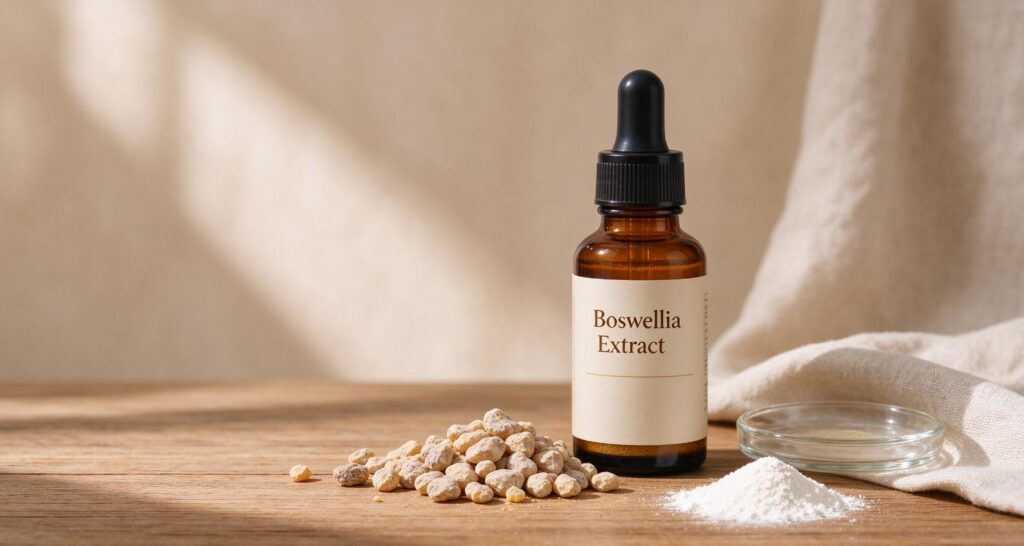
Boswellia extract, derived from the gum resin of Boswellia serrata trees, has been used in Ayurvedic medicine for centuries to treat inflammatory conditions. At its core lies boswellic acid, a pentacyclic triterpene that has attracted significant attention from modern researchers for its ability to modulate inflammatory pathways without the gastrointestinal side effects associated with conventional NSAIDs.
For B2B buyers and formulators seeking natural anti-inflammatory ingredients, boswellia represents a compelling option: one with deep traditional roots, growing clinical validation, and applications spanning joint health supplements, sports recovery, and functional foods.
What Is Boswellia Extract?
Boswellia extract is obtained from the gum resin of Boswellia trees, primarily Boswellia serrata (Indian frankincense), Boswellia carterii, and Boswellia frereana. The resin is harvested by tapping the tree bark, then purified and standardized through solvent extraction and spray drying.
The active compounds are boswellic acids, a group of pentacyclic triterpene acids. Among these, 11-keto-β-boswellic acid (KBA) and 3-O-acetyl-11-keto-β-boswellic acid (AKBA) are considered the most pharmacologically active. Commercial boswellia extracts are typically standardized to 30%, 65%, or 95% boswellic acids, with AKBA content often specified separately (e.g., 10%, 30%, or 50% AKBA).
Unlike salicin, which is a prodrug converted in the body, boswellic acids act directly on inflammatory enzymes. This difference in mechanism explains boswellia’s distinct therapeutic profile and makes it particularly suitable for formulations targeting chronic inflammation.
Mechanism of Action: A Multi-Target Anti-Inflammatory
Traditional NSAIDs work by inhibiting cyclooxygenase (COX) enzymes. Boswellia works through a different pathway, which is critical for product development.
5-LOX inhibition. Boswellic acids are direct inhibitors of 5-lipoxygenase (5-LOX), the enzyme responsible for producing leukotrienes — inflammatory mediators that play a key role in conditions like asthma, arthritis, and inflammatory bowel disease. This mechanism is distinct from COX inhibition, meaning boswellia may complement rather than duplicate NSAID action.
NF-κB and MAPK pathway modulation. Research shows that boswellic acids suppress the NF-κB signaling pathway, a master regulator of inflammatory gene expression. They also inhibit MAPK pathways, which are involved in cellular stress responses and cytokine production. This dual action underpins boswellia’s broad anti-inflammatory effects.
Gastroprotective profile. Unlike many conventional anti-inflammatories, boswellia has not been associated with significant gastric ulceration in clinical studies. This makes it particularly attractive for individuals who cannot tolerate NSAIDs or who are seeking long-term joint support without gastrointestinal concerns.
Anti-arthritic activity. Beyond inflammation, boswellic acids have demonstrated the ability to inhibit matrix metalloproteinases (MMPs), enzymes that degrade cartilage. This suggests a potential disease-modifying effect in osteoarthritis, not just symptom relief.
Clinical Evidence and Standardization
Boswellia extract, standardized to its boswellic acid content, has been the subject of multiple randomized clinical trials.
Osteoarthritis. A well-known double-blind study enrolled 30 patients with knee osteoarthritis and randomly assigned them to receive either boswellia extract (standardized to 30% boswellic acids) or placebo. After eight weeks, patients in the boswellia group showed significant reductions in pain and swelling, and improved knee flexion, compared to placebo. A larger follow-up study confirmed these findings, with 67% of patients reporting reduced knee pain.
Rheumatoid arthritis. A separate study examined boswellia’s effects in patients with rheumatoid arthritis. Results showed reduced joint swelling, pain, and stiffness, with improvements in inflammatory markers such as ESR and CRP.
Comparison with standard treatments. In a head-to-head study comparing boswellia extract to valdecoxib (a COX-2 inhibitor) in patients with osteoarthritis, both treatments produced similar improvements in pain and function. However, the boswellia group showed better tolerability and no significant adverse events.
Standardization grades. The market has responded with standardized boswellic acid grades, most commonly 30%, 65%, and 95%. The 30% grade remains the standard for general joint health supplements, while higher concentrations (65% and 95%) are used in clinical-use formulators and evidence-led brands seeking smaller serving sizes or a more focused active profile.
Market and Regulatory Landscape: A Growing Global Opportunity
Boswellia is no longer a niche ingredient. The global boswellia extract market is expanding across multiple formats and regions.
Regulatory status. In the United States, boswellia extract is regulated as a dietary supplement ingredient. In Europe, it is used in traditional herbal medicinal products, with monographs available for Boswellia serrata in some countries. In China, boswellia is recognized in traditional medicine and is increasingly used in health products.
Market growth. The global boswellia extract market is projected to grow steadily, driven by consumer demand for natural anti-inflammatory alternatives and clean-label botanical ingredients. North America and Europe hold the largest shares, supported by established supplement distribution channels. Asia-Pacific is forecast to grow fastest, with China serving as both a major supply base and a growing domestic market.
Format trends. Capsules and tablets dominate, favored for precise dosing in pharmacy channels. Powder is the fastest-growing format, driven by sports nutrition and contract manufacturing demand for flexible blending. Gummies and functional beverages are also emerging as delivery formats.
Indication trends. Osteoarthritis and joint discomfort dominate, followed by rheumatoid arthritis, sports recovery, and general inflammation support. Respiratory health (asthma, bronchitis) is a secondary but growing application.
Consumer trends. Brands are increasingly incorporating boswellia into joint health and sports recovery products, focusing on clean-label and plant-based positioning. The broader shift toward natural, plant-based health products continues to drive demand for ingredients with both traditional credibility and modern scientific validation.
Product Specifications and Quality Control
As a B2B ingredient, the core value of boswellia lies in purity, standardization, and batch-to-batch consistency.
Typical specifications. Commercial grades are classified by boswellic acid content. Standard grades typically contain 30% boswellic acids, suitable for general joint health supplements. Mid-grade products contain 65% boswellic acids, offering a more concentrated active profile. Premium high-purity grades reach 95% boswellic acids, delivering a focused active for clinical-use formulators and evidence-led brands. AKBA content is often specified separately.
Physical and chemical parameters. Boswellia extract is a white to off-white crystalline powder, soluble in ethanol and partially soluble in water. It exhibits good stability under normal storage conditions and is compatible with common excipients used in capsule and tablet manufacturing.
Heavy metal limits. Lead ≤1ppm, Arsenic ≤1ppm, compliant with FCC and JECFA specifications.
Documentation support. For B2B buyers, complete documentation is essential: COA, MSDS, specification sheet, and third-party test reports covering heavy metals, microbials, and residual solvents, as well as non-GMO and allergen statements where applicable.
Application Scenarios and Formulation Strategies
Joint health supplements. The largest application category. Boswellia is used in capsules, tablets, and powdered drink mixes targeting arthritis, joint discomfort, and inflammation. The key challenge is achieving a clinically effective dose while maintaining a manageable serving size. Common strategies include using higher-purity grades (65% or 95%) to reduce capsule count, and blending with other joint-health ingredients such as glucosamine, chondroitin, or turmeric extract.
Sports recovery and inflammation support. Boswellia is used in products targeting muscle soreness, exercise-induced inflammation, and recovery. Its 5-LOX inhibition offers a complementary mechanism to COX inhibitors, appealing to athletes seeking natural options with fewer gastrointestinal concerns.
Respiratory health. Emerging application. Boswellia’s leukotriene inhibition positions it as a promising ingredient for respiratory support products, including those targeting asthma and bronchitis. Formulators can combine boswellia with other respiratory-support ingredients such as quercetin or vitamin C.
Functional foods and beverages. Boswellia can be incorporated into functional foods and beverages targeting inflammation and joint health, though taste considerations may require masking strategies.
Safety and Regulatory Considerations
Boswellia extract has a favorable safety profile, but important caveats apply.
Toxicity data. Toxicological studies on boswellia extract have shown no significant adverse effects at commonly used doses. In animal studies, oral administration of boswellia extract at doses up to 2000 mg/kg body weight did not produce mortality or significant organ toxicity.
Precautions. Individuals with known allergies to boswellia or related plants should avoid it. Boswellia may have mild blood-thinning effects and should be used with caution by individuals on anticoagulant medications. Pregnant and breastfeeding women should consult a healthcare provider before use.
Drug interactions. Boswellia may interact with anticoagulants (such as warfarin), antiplatelet drugs, and medications metabolized by the liver. Patients taking these medications should consult a healthcare provider before use.
Regulatory implications for B2B buyers. Regulatory status varies by market. In the United States, boswellia extract is regulated as a dietary supplement ingredient. In Europe, it is used in traditional herbal medicinal products. Product labels and claims should strictly comply with local regulations.
Why Choose Our Boswellia Extract?
As a professional botanical extract supplier, we offer boswellia products that meet B2B buyer requirements:
Multiple grades for diverse applications. From standard 30% boswellic acids for cost-sensitive applications to high-purity 95% grades for clinical-use formulators, we provide specification options to match your formulation and budget.
Complete documentation support. Every shipment includes COA, MSDS, specification sheet, and third-party test reports covering heavy metals, microbials, and residual solvents.
Flexible supply. Minimum order quantities as low as 1 kg for trial orders, with scalable pricing for commercial volumes.
Boswellia is not a trend ingredient — it is a plant-derived compound with decades of clinical research, well-characterized mechanisms of action, and broad application prospects. For formulators building joint health supplements, natural anti-inflammatory products, or respiratory support formulations, it deserves serious evaluation — but only with a clear understanding of its dosing challenges and formulation strategies.
Ready to try Boswellia Exract for your business? Contact us at info@xianherb.com for a free sample or wholesale price list.
Leave A Comment